Using #MacroSW in the Classroom
 #MacroSW is a live weekly Twitter chat for anyone interested in macro-level social work practice. The chat partners include practitioners and academics with a passion for working with policy, communities and organizations. In full self-disclosure, I have been an active partner with #MacroSW for almost a year now, and value the opportunity to be part of this online community.
Why use #MacroSW in the classroom?
Simply put, it is an incredibly engaging way to learn about macro social work practice. When students participate in an hour-long chat, they are engaging in the principles of Connected Learning, a theory that incorporates the digital technology into the learning process (Ito et al., 2013). Connected Learning suggests that learning in the 21st century must be driven simultaneously by the interests of the learner (Interest-Driven) and the academic requirements (Academically-Oriented) while occurring in an environment that supports openness, sharing and feedback with peers and others (Peer-Supported) (Ito et al., 2013). For example, if the goal of your class is for students to learn social work practice with communities and organizations, #MacroSW offers weekly topics related to social welfare policy, research, and practice with community and organizations (Interest-Driven) that are hosted and attended by a variety of social work professionals including students, academics, policy analysts and practitioners (Peer-Supported). Each chat includes a blog post on our website, numerous resources for the week’s topic, and a chat transcript which allow any social work educator to easily incorporate #MacroSW into a course or a specific assignment (Academically-Oriented).
How can you incorporate #MacroSW into your class?
There are four things you want to consider when creating an assignment with #MacroSW in your class:
1. Setting-up a Twitter Account: Students will need to create a free Twitter account, understand the basics of how to use Twitter, and be familiar with how to participate in a live chat. As the instructor, you will want to model for your students so set-up your own account too. Here are some resources:
Educational Outcomes for Live Tweeting with Students
My first article of 2016 is co-authored with my good colleague, Jimmy Young from California State University San Marcos, and is about using live tweeting with social work students. Here is a link to the article (with free access for the first 50 copies): Tweet, Tweet!: Using Live Twitter Chats in Social Work Education.
First, I want to thank my colleagues with #MacroSW Chat. Their support and willingness to collaborate helped to make this assignment and study possible.
We conducted a small pilot study to see what our students thought about using Twitter in the classroom. Jimmy and I have long supported the use of social media in social work education as a tool for professional development. When students know how to use social media as a professional social worker, they will have a better understanding of the role of social and digital media in the life of 21st Century social workers, including the benefits of creating professional learning networks and the pitfalls of potential ethical dilemmas.
Job Shadowing on Twitter
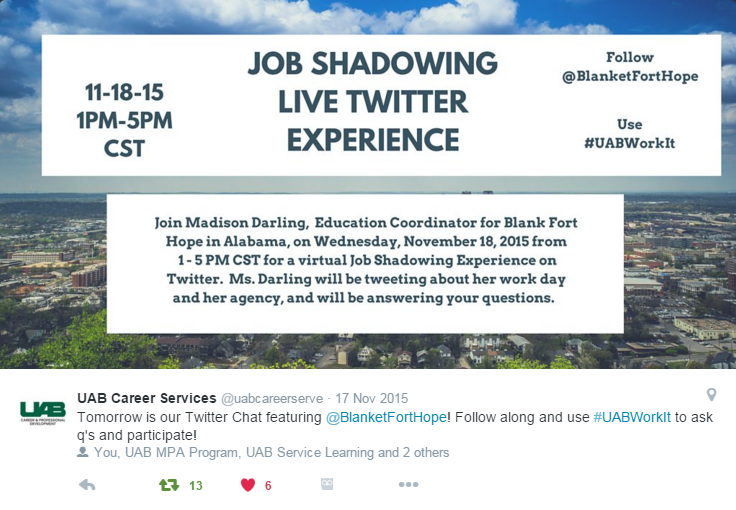 I’m always looking for a new way to incorporate Twitter into my social work courses. So I was pleased when my colleague Joy Jones with UAB’s Career and Professional Services suggested a new idea to me – a virtual job shadowing experience on Twitter. The event goes like this – a professional agrees to tweet about her job during a set date and time, students can follow along via Twitter, and then tweet back questions or comments to the professional. Similar to a live twitter chat, students can use a computer, tablet or mobile device from anywhere, offering flexibility and the opportunity to engage with others who are also following the job shadowing. Joy had all the details worked out for an event including the job shadowing candidate, logistics, and a hashtag. All I had to do was recruit the students. I offered it as an extra credit opportunity for students in my two classes last semester.
The event happened on 11/18/15 from 1 – 5 pm with Madison Darling from Blanket Fort Hope, a local non-profit agency in Alabama fighting child human trafficking. Madison agreed to tweet every 30 minutes about what she was doing that day and answer questions from students as frequently as possible. We had about fifteen participants total, along with myself and Joy. Questions ranged from “what is like working with children” to “how do I volunteer with your agency.” Madison and one of her colleagues did a great job answering questions and sharing about their agency and their job duties. Not only were my students able to network with professionals, a connection was created between my academic department, our campus career services and a community partner. Click here for a link to the transcript from the event, where you can read the tweets.
Joy and I will working on more of job shadowing events in the coming semester, and here are some suggestions I have for other social work faculty interested in hosting a similar event and/or incorporating this type of job shadowing into a learning activity:
#APM2015 Using Documentaries and Twitter to Meet Macro/Policy Objectives in Social Work Education
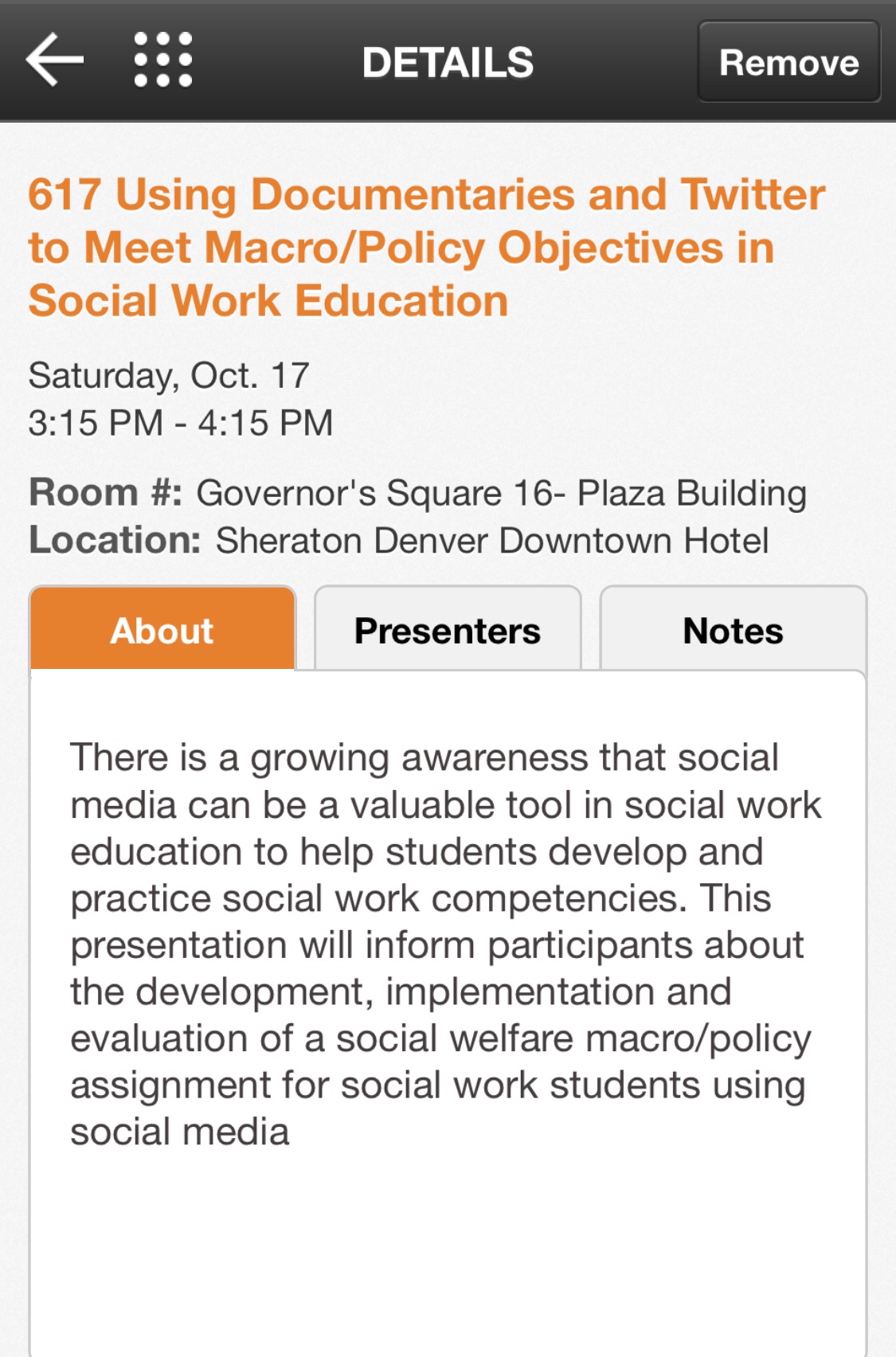
 Today, Dr. Jimmy Young and I are presenting at the 61st Annual Program Meeting of the Council on Social Work Education about our social media assignment using a documentary movie and Twitter. There is a growing awareness that social media can be a valuable tool in social work education to help students develop and practice social work competencies. This presentation will inform participants about the development, implementation and evaluation of a social welfare macro/policy assignment for social work students using social media. In our session, we will The learning objectives for this session include:
1. Understand how the social media platform Twitter can be incorporated into assignments for social work policy and macro courses.
2. Demonstrate how social work educators can assess attainment of competency among social work students using a social media assignment paired with a Rubric for evaluation of the assignment’s learning outcomes.
3. Appreciate the role of professional collaboration in the development, implementation and evaluation of social media-based assignments.
Here is a link to the Prezi that we will show during the presentation.
Fall 2015 Live Twitter Chat Assignment for Social Work Students
 To help social work students and educators learn about Twitter and develop the skills to participate in a live chat, Jimmy Young of the California State University San Marcos and I (Laurel Hitchcock of University of Alabama at Birmingham) have designed an assignment for social work students that involves joining a live Twitter chat with other social work students, educators and practitioners from around the country to talk about important social and economic justice issues. The assignment is designed for a policy or macro-practice course, but it can be incorporated into almost any social work course. Here are the some of the details of the assignment:
1. Students watch the documentary Inequality for All, and then write a brief reaction paper to movie.
2. Then, students participate in the live Twitter chat scheduled for October 8, 2015 at 8:00 PM CST/6:00 PM PST. This chat will be sponsored by #MacroSW, a bi-weekly Twitter chat focusing on macro social work practice issues, and hosted by myself & Jimmy. During the chat, we will ask questions about the film and income inequality that will guide the flow of the conversation.
3. After the live chat, students write a brief self-reflection essay about the experience of participating in the chat.
While the written parts of the assignment are optional to participate in the chat, we highly recommend some type of reflection so students are engaged with the content from the documentary prior to the chat, and have an opportunity to critically assess how the experience can inform their future social work practice. We have written in more detail about the assignment in previous blog posts which include detailed instructions for the assignment, grading rubrics and tips on how to introduce your students to Twitter. Our first chat was held on October 28, 2014, and you can read details about it here, including a transcript of tweets from the conversation. There is no cost to educators or students to participate in the chat, and we welcome anyone, especially social work practitioners, to join the chat.
Because we are working to improve the chat and the assignment as an educational experience for social work students, we are very interested in any feedback from social work educators. Please contact us (by clicking on our names below) if you plan to have your class or maybe a student group participate in the chat. We also welcome questions.
How to cite this post:
Hitchcock, L. I. (2015, October 2).Fall 2015 Live Twitter Chat Assignment for Social Work Students[Blog Post]. Retrieved from https://laureliversonhitchcock.org/2015/10/02/fall-2015-live-twitter-chat-assignment-for-social-work-students/.
Call for Contributions – Assignment Compendium for Book on Teaching Social Work with Digital Technology
Dear Social Work Colleague,
You are invited to contribute to an assignment appendix on a book that is tentatively titled Teaching Social Work with Digital Technology, due to be published with CSWE Press in 2016. The book authors are Laurel Hitchcock, Melanie Sage, and Nancy Smyth. The deadline for submissions is September 30, 2015.
The assignment appendix will be resource of contributed assignments or class activities that either educate about, or rely on the use of, technology in social work practice and education. We welcome contributions in which technology plays a supporting role or where technology competency is the practice outcome. For example, assignments may instruct students to: 1) develop a press release about research and announce it via social media: 2) use a videolog to demonstrate a clinical technique; or 3) use Twitter to communicate with a policy-based agency. We expect to include about 50 contributions. This appendix of assignments will be divided by curricular areas (Practice, HBSE, Policy, Research, and Field Education). We envision the appendix as an important resource for educators of all proficiency levels. Each assignment contribution should be about one page; contributions may be edited for clarity or space. You can submit as many assignments as you would like. Please submit each assignment separately. A sample assignment is available at: https://www.dropbox.com/s/ro4qy5z0ay8xodm/sample.pdf.
Please submit your contribution at this website: https://und.qualtrics.com/SE/?SID=SV_1HSOGmgInnDPSnP. At the site, you will be asked to give the submission a title, identify the social work curricular area, practice competencies, to explain the assignment as you would to a student (300-600 words), provide the time and technology requirements, and note any other necessary information for instructors.

Teaching & Learning in Social Work by Laurel Iverson Hitchcock is licensed under a Creative Commons Attribution-NonCommercial-ShareAlike 4.0 International License