Social Media How-To Guide for Social Work Educators
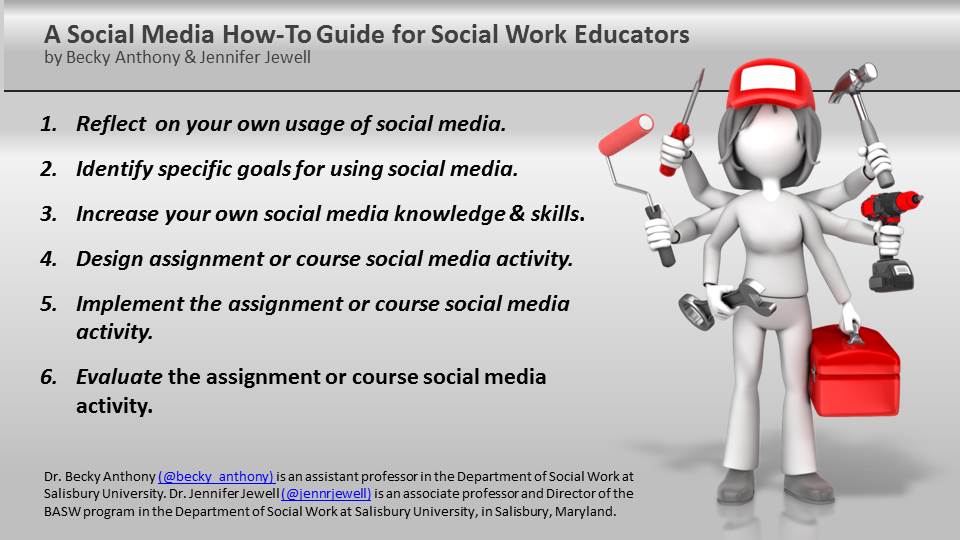 This post was written by Drs. Becky Anthony and Jennifer Jewell. Dr. Becky Anthony (@becky_anthony) is an assistant professor in the Department of Social Work at Salisbury University. Dr. Jennifer Jewell (@jennrjewell) is an associate professor and Director of the BASW program in the Department of Social Work at Salisbury University, in Salisbury, Maryland. In this blog post, they write a guide for how social work educators can best utilize social media to meet their educational goals.
With the changing nature of educational delivery and knowledge consumption, social work educators are increasingly utilizing social media to help students meet course learning goals and objectives. Students are able to use social media to network with social work professionals, enhance connections between peers, advocate and raise awareness about social concerns, and find resources that help them practice effective social work (Jewell & Anthony, 2016). Some social work educators want to utilize social media in their courses to help students meet learning goals, but are unsure about how to get started. This blog post reviews steps to help social work educators prepare and implement social media assignments and activities into the classroom.
STEP 1: Think about and reflect on your own usage of social media. You need to determine what you will do to abide by professional ethical standards, maintain your own personal boundaries, and explore how you will utilize social media. In this first step, you will create social media guidelines for the course, the department, and/or the professional self. Laurel Hitchcock provides an effective and thorough example of that here: My Guidelines for using Digital and Social Tech in the Classroom and Beyond. This first step allows you to learn about your own professional usage of social media and your own personal boundaries and professional ethics.
STEP 2: Identify specific goals for using social media in this course or with this specific assignment. Once goals are established, you will need to research the different tools (specific social media platforms). For example, Instagram is utilized to share photos and videos and Twitter only allows for 140 characters in each post. Social work educators, during step two, should answer the following questions: 1. What do you want the students to learn? 2. What social media method will work best to achieve this goal?
STEP 3: Increase your own social media knowledge and skills. Specifically, focus on the social media platform you will utilize in your course. You will find it helpful to create an account (if you do not already have one), watch tutorial videos online, utilize tip guides, and practice using this social media before asking your students to use it. This becomes very important because a number of students will not have previously utilized this social media platform and will ask you questions about how to get started and where to find resources.
Revised Technology-Based Learning Task List for Social Work Education
 Back in April 2016, Melanie Sage, Nancy Smyth, and I first shared a list of technology-based learning activities that we developed based on Council on Social Work Education’s Social Work Competencies from the 2015 Educational Policy and Accreditation Standards (EPAS). The purpose of this list is to help social educators infuse learning about and with technology across the social work curriculum. We have updated our list to keep with the evolving understanding of how to apply CSWE’s 2015 EPAS. Here are the main features of the list:
– Over 100 different example assignments and learning tasks with brief directions that can be incorporated into social work courses across the curriculum.
– Assignments are designed to encourage students to share their work with a class/seminar or practicum field instructor.
– For assessment purposes, each assignment and learning task is grouped by competency and component behaviors, and then labelled with the relevant competency dimensions using the following key: K = Knowledge; V=Values; S= Skills; and CA = Cognitive and Affective Processes.
You can access the new version of the list here: Technology-Based Learning Task List for Social Work Education (Version 1.1 – 6/13/16)
#SWDE2016 Teaching & Learning Professional Social Work Skills w/ Twitter
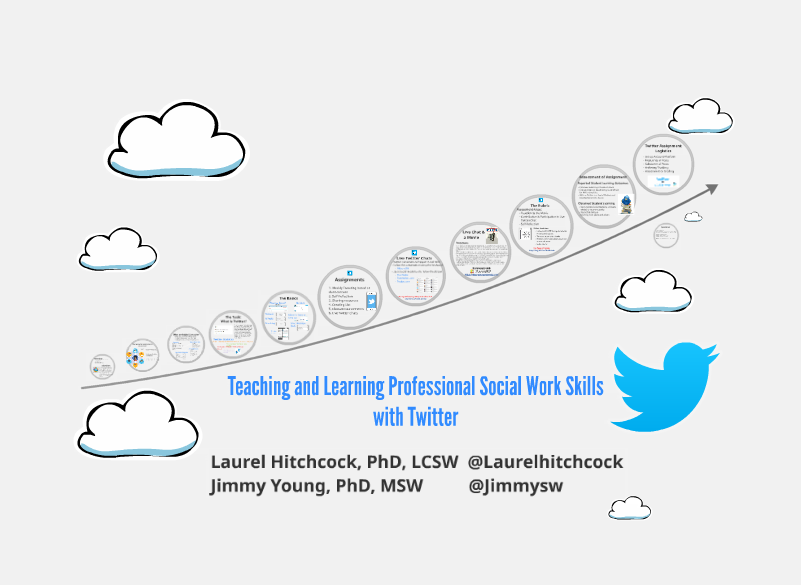 On Day Two of the Social Work Distance Education Conference, I will be presenting a workshop about the work Jimmy Young and I have done with Twitter in the classroom. If you are at the conference today, please join me in the B& O Room at 3:45 PM for the workshop. Our work focuses on the growing awareness that Twitter, a micro-blogging social media platform, can be a valuable tool in social work education to help students develop and practice social work competencies. This workshop will inform participants about the development, implementation and assessment of different assignments using Twitter for teaching social welfare policy and macro social work practice. Sample assignments, practical tips and a demonstration of Twitter will be provided to participants. The learning objectives for the workshop include:
1.Understand how the social media platform Twitter can be incorporated into assignments for social work courses to advance learning of the profession’s competencies.
2. Demonstrate how social work educators can assess attainment of competency among students using a social media assignment paired with a rubric for evaluation of the assignment’s learning outcomes.
3. Appreciate the role of professional collaboration in the development, implementation and assessment of social media-based assignments.
Here are some of the resources from the workshop:
Prezi Slides – Teaching & Learning Professional Social Work Skills w/ Twitter Workshop
How to Participate in a Live Twitter Chat – Tips for Social Workers
#SWDE2016 Incorporating Digital & Social Technologies into Social Work Education
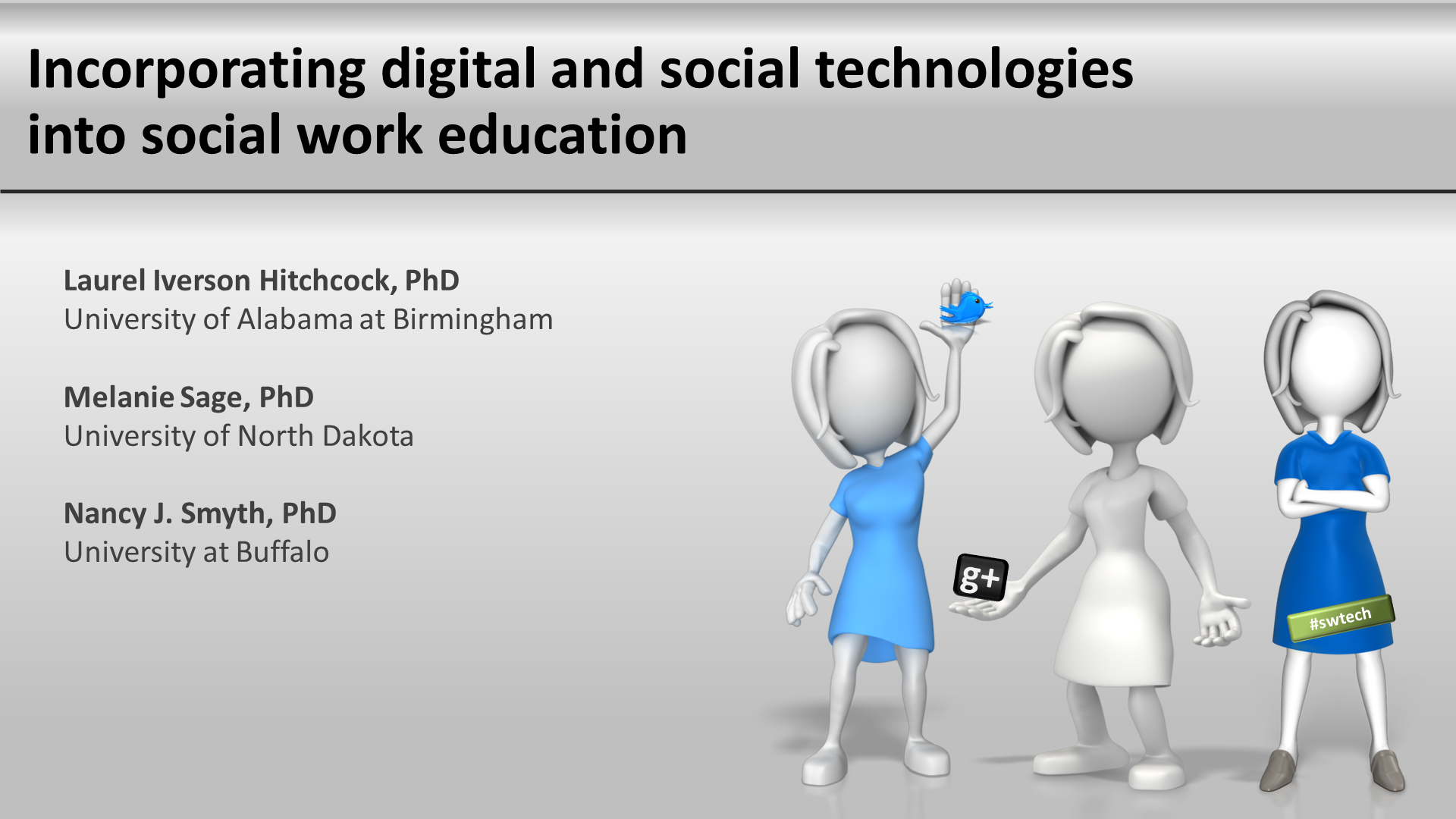 Today is the Day 1 of the Second Annual Social Work Distance Education Conference, and I am lucky enough to be presenting with Drs. Melanie Sage (University of North Dakota) and Nancy J. Smyth (University of Buffalo, SUNY) about how to incorporate digital and social technologies into social work education. Our workshop will inform participants about the mechanics as well as the advantages and disadvantages of incorporating digital and social technologies assignments into social work courses. Topics to be covered include the importance of digital literacy and how to use theory to inform the integration of technology into their online courses. Participants will learn about example assignments and learning activities for social work courses that incorporating digital and social media such as microblogging, designing infographics, and creating a video. By the end of the workshop, participants will:
1. Understand the importance of digital literacy in 21st century social work practice.
2. Demonstrate how digital and social technologies can be incorporated into assignments for social work courses.
3. Appreciate the role of theory to support the development and implementation of technology-based assignments.
Here is a link to the slides from the workshop: https://www.slideshare.net/secret/8jgUUNwPcTPt46.
We also shared the following handout: Technology-Based Learning Task List for Social Work Education.
Using Pinterest in Undergraduate Social Work Education – #BPDTX16
 March 31st will be Day Two for me at #BPDTX16 and I will be presenting on how Pinterest can be incorporated into undergraduate education. My UAB colleague, Dr. Lisa Baker, and I developed and implemented a social media-based assignment using Pinterest in our HBSE course sequence last year. Even though Lisa won’t be able attending BPD this year, I’m looking forward to talking about this assignment and our assessment outcomes. The session is from 11:15 AM-12:30 PM in Majestic 4 on 3/31/16.
We will focus on how practitioners are increasingly using social media to interact with client systems. As such, educators and students should recognize the role social media plays in developing practice related competencies and connecting to a larger learning network. Our workshop presents the development, implementation and evaluation of Pinterest assignments in undergraduate education.
Learning objectives for this session include:
1. Participants will explore the use of Pinterest as a teaching tool in undergraduate courses, following an evidence-based model of assignment development, implementation and evaluation.
2. Participants will become aware of the context in which students complete social media assignments and the role social media plays in helping students develop professional self.
3. Participants will discuss caveats to developing social media assignments and learn how such assignments help develop practice competencies.
Here is a link to the slides from the presentation: Using Pinterest in Undergraduate Social Work Education Slides on SlideShare.
Also, you can download the two rubrics from the presentation here:
Social Media and Technology Basics for the Social Work Educator – #BPDTX16
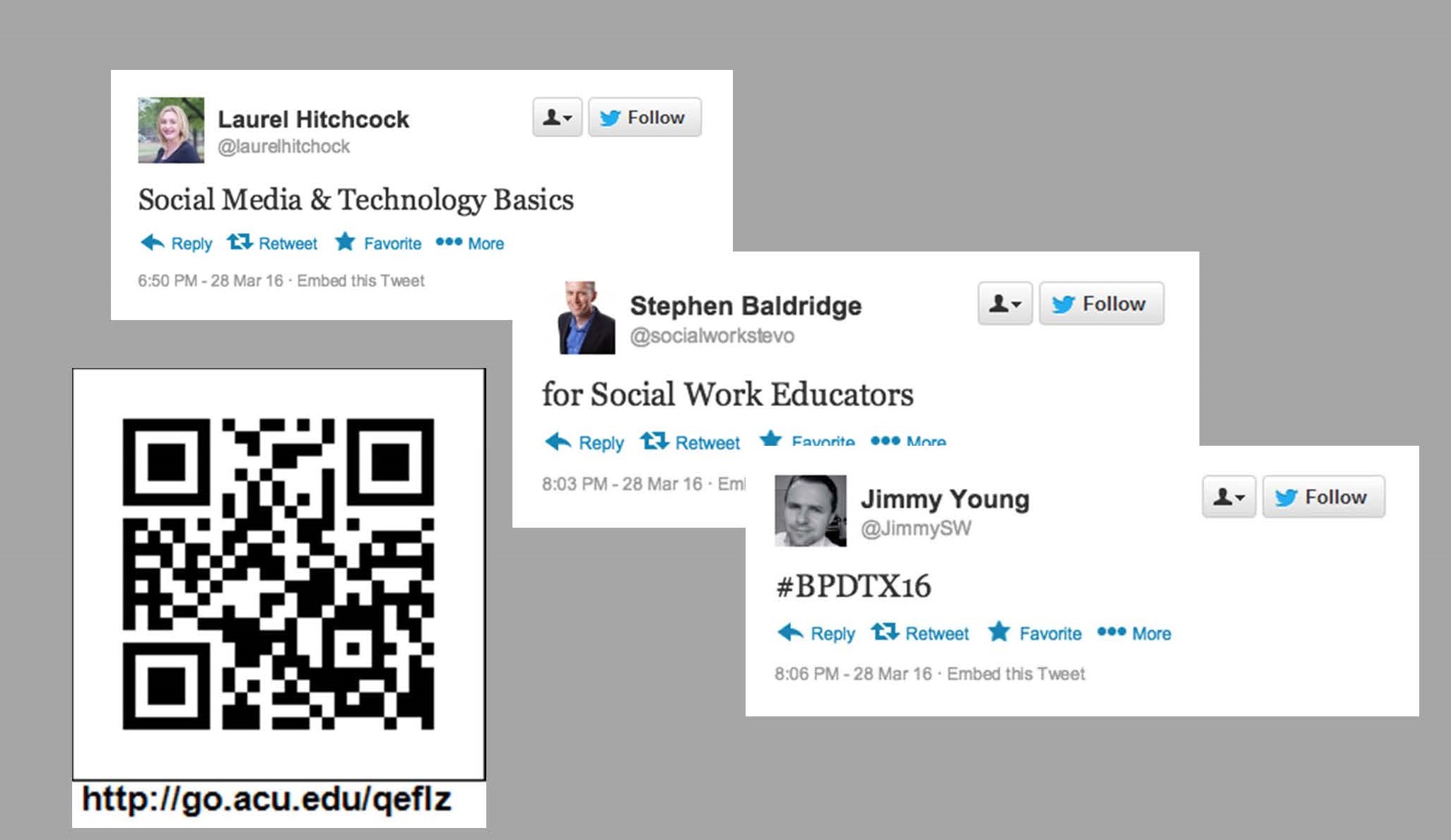 Welcome to #BPDTX2016! Stephen Baldridge of Abilene Christian University and I are facilitating a pre-conference workshop about social media basics for the social work educator on 3/30/16 from 1:00 – 4:00 PM. We originally created this workshop with Jimmy Young of California State University – San Marcos, but he won’t be making it to BPD this year.
Our goal for the workshop is to introduce social work educators to the world of social and digital technologies that can be effectively incorporated into the classroom. We will help bridge the gap between understanding and best practice by demonstrating how to use some of the social media platforms. Upon completion, participants will have several practical, “usable” tools to immediately implement in their courses.
Learning Objectives for the workshop include:
1. Understand how a minimum of 3 social media platforms can be incorporated into assignments for social work courses.
2. Recognize/identify a minimum of 2 ways using social and digital media can promote professional development among social work educators.
3. Appreciate the role of collaboration to support the development and implementation of technology-based assignments.
Slides for the presentations can be accessed here: http://www.slideshare.net/secret/CSjdjAcaZ9UYHo
Here is a link to my blog post about My Guidelines for using Digital & Social Tech in the Classroom and Beyond.


Teaching & Learning in Social Work by Laurel Iverson Hitchcock is licensed under a Creative Commons Attribution-NonCommercial-ShareAlike 4.0 International License