In Loving Memory of Dr. Melanie Sage
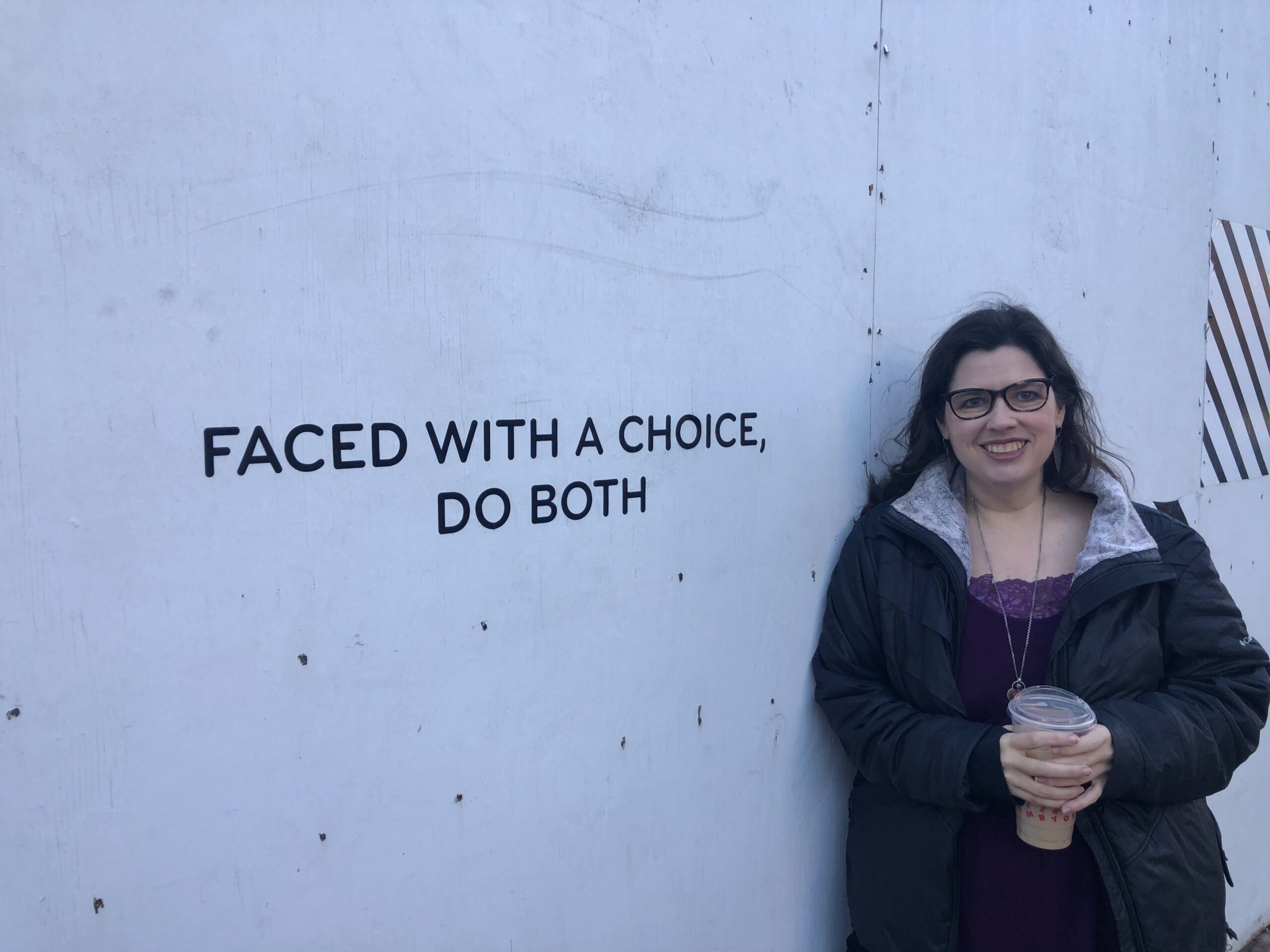
I don’t know if you’ve heard yet. Our friend and colleague, Dr. Melanie Sage, passed away on May 15th in Mexico following complications from surgery. Her husband, Todd and her family just finished an impossible week of getting Melanie home to the States. Four days in an ICU in Mexico came with costs that Todd and his family did not see coming. They had to work with an attorney to bring Melanie home to the States.
I wanted to reach out personally because Melanie mattered to me, and I imagine she mattered to you, too.
In partnership with Todd, we have set up a GoFundMe to help cover the costs of her care and bringing her home. Here is the link: GoFundMe for Dr. Melanie Sage
If you can give, please do. If you can share it, that matters just as much.
As for what comes next: Melanie was a simple, loving person and did not want a big funeral. She told Todd in the ICU that she wanted to be cremated and have her ashes spread in some of her favorite places, and that she wanted a celebration of life instead of a service.
She had one specific request for that celebration. She wanted everyone who loved her to write her a poem. Write about her, about you, and about the two of you together, whatever you want to say to her.
We have two options for sharing your poem:
- You can email the poem to wesocialworkllc@gmail.com. We will be posting them (with your permission) on the WeSocialWork website. Please also feel free to share a photo of you and Melanie to accompany your poem.
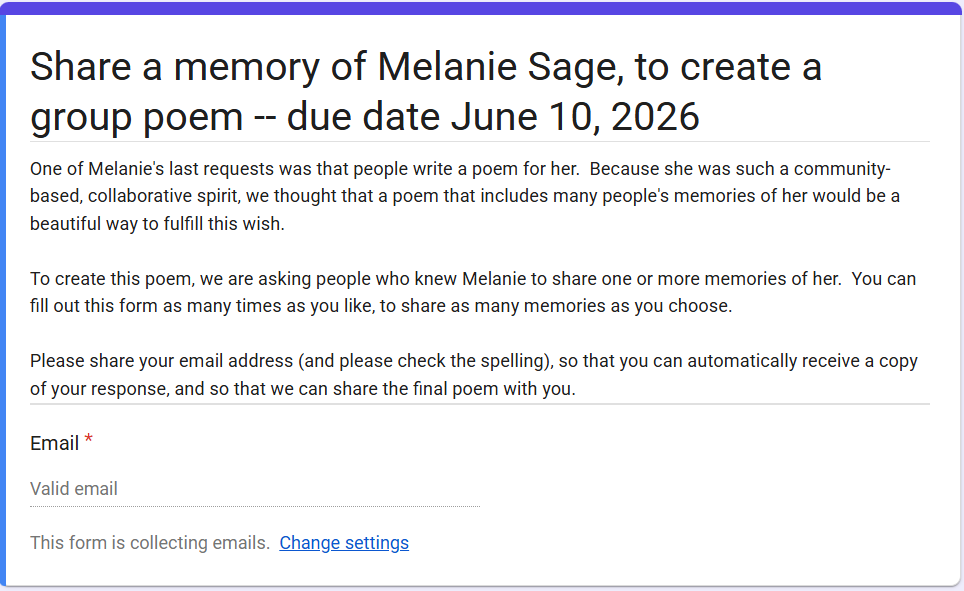
- You can contribute to creating a group poem for Melanie by completing this Google Form.
- And you can do both!
Todd knows many of her friends live far away and may not be able to attend the celebration of life in person. If that is your situation, please feel free to mail or email your poem to me, or simply keep it close to yourself as your own way of remembering her.
Please share this information with others as you can and want.
Making AI Use Visible: Why I Ask Students to Document Their Process
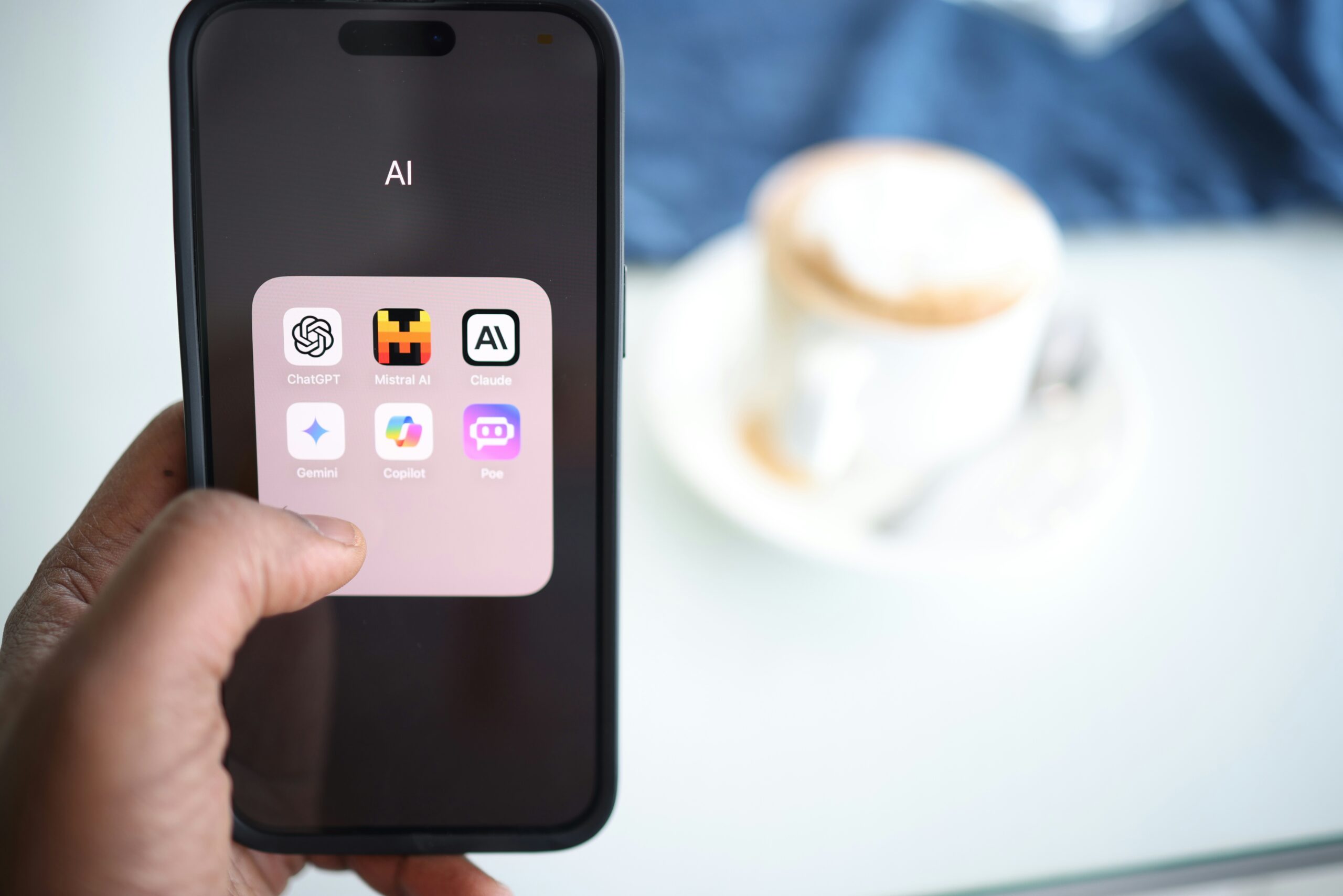
I use Generative AI tools, and started using them when they were first released. You can see how I started using AI to help with my work in this article that I published with colleagues in 2024 in the Journal of Social Work Education:
Báez, J. C., Bjugstad, A., Park, T. K., Jones, J. L., Bidwell, L. N., Sage, M., & Hitchcock, L. I. (2025). Social Work Educators Innovating With Generative AI: An Exploratory Study. Journal of Social Work Education, 61(1), 14–29. https://doi.org/10.1080/10437797.2024.2411170
As I reflect on this article now, I still see the role of AI tools in my work life as one of augmentation or support. The tools help me organize my thinking, draft an outline or get unstuck when I have a writing block. My confidence in using AI tools responsibly is rooted in professional identity, judgment, and ethical accountability. Students, by contrast, are encountering these tools at the same time they are learning what it means to think, write, and reason as social workers. Generative AI tools such as ChatGPT, Grammarly, Copilot, and others are now embedded in students’ daily writing environments. Some students are using these tools deliberately; others may not fully realize when browser extensions or autocomplete features involve AI. Meanwhile, our assignments in social work education are often writing-focused, inviting reflection, analysis, integration of theory and experience, and the development of critical thinking that grounds ethical practice.
Navigating AI in Social Work Education
Editor’s note: In this blog post, four social worker educators share a sample from their new and free resource about using Artificial Intelligence (AI) in social work education. Alexander Rubin, LCSW, is a clinical assistant professor based in field education at the University at Buffalo School of School of Social Work. He specializes in community partnership development, field-specific teaching, and innovation in field education. Michael Lynch, LMSW, is a clinical associate professor at the University at Buffalo School of Social Work. He specializes in experiential learning, community partnerships, and the use of technology in social work practice and education. Todd Sage, Ph.D., MSW, is a clinical associate professor at the University at Buffalo School of Social Work. He is the chemical dependency track coordinator and mental health track chair. He researches technology and child welfare and enjoys integrating emerging technologies in the classroom and as a field instructor. Melanie Sage, Ph.D., LCSW, is a tech consultant for universities, social work departments, and social work agencies. She is an expert in generative AI, machine learning in social work, social media use, online education, and teaching with technology. She also works with agencies to train staff in Motivational Interviewing.
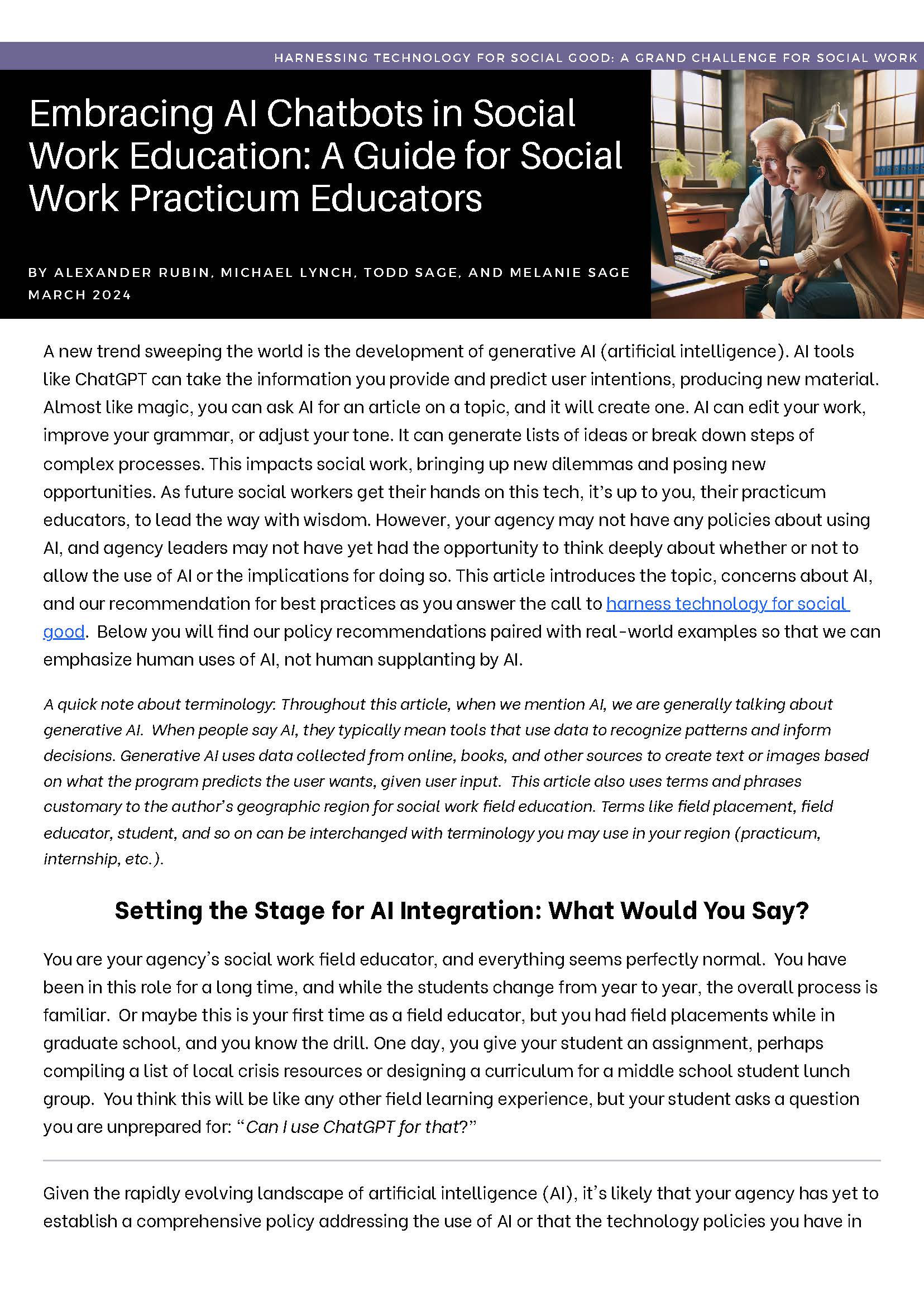
As social work educators, we find ourselves at a point where the capabilities of generative artificial intelligence (AI) tools like ChatGPT intersect with our professional practice more and more often, and we ponder these challenges with much philosophical debate in academic settings. But we send our students out to their practicum sites, and the debates are no longer philosophical; real-life decisions affect agencies, students, and clients, and these challenges must be thoughtfully and practically addressed. The emergence of AI has outpaced the development of comprehensive policy in numerous professional settings. This is why we wrote an article to offer guidance and considerations for the social work field educator with a student placed in their agency. Our goal is to introduce use cases, debates, and potential policies. The full article can be downloaded here and shared with your local social services agencies.
Using Artificial Intelligence in Social Work Field Education
Editor’s Note: Jacqueline Jones is the MSW Field Coordinator at the University of Alabama at Birmingham and one of my colleagues in the UAB Department of Social Work. She has over six years of experience supervising students during field placements and eight years of social work practice experience. In this blog post, she shares how she uses artificial intelligence tools to improve her teaching and save time.
I think, in many ways, social workers shy away from technology and, seemingly, advanced computer systems. In an ever-evolving world where social media, email, and searching the World Wide Web are literally at our fingertips, I believe social workers should embrace the use of technology in their practice and what it is capable of doing to help not only us but our clients, too.
I will expand on using one specific realm of technology in social work education: artificial intelligence or AI. Currently, I serve as the Masters of Social Work (MSW) Field Coordinator at the University of Alabama at Birmingham, which means teaching seminar courses for field education. This semester, I decided to use AI to assist me in developing in-class activities for my MSW students.
What is AI? Here is the answer that ChatGPT gave me in a matter of seconds to give you a glimpse of what AI can do.
Technology Disruption Readiness Plan: A Best Practice for the Social Work Classroom
In social work education, one lesson we can take away from the COVID pandemic has brought many lessons to social work education is to be ready when a crisis or disruption requires an instructor and students to quickly shift an entire course, a class session, or even an assignment. In today’s world, this typically means understanding when and how to adapt our learning environments to incorporate or adjust for digital technologies, both hardware (i.e., portable devices, laptops, WiFi access) and software (i.e., learning management systems). A social work educator can prepare for future disruption in their classroom by developing a course-level Technology Disruption Readiness Plan. Such a plan aims to thoughtfully and systematically think through how one will manage disruptions due to technology to the educational process and then share this information with students. This approach is recommended in the NASW Standards for Technology in Social Work Practice under Standard 4.06 Technological Disruptions, which focuses on what to do when technology fails with online teaching, such as a power outage or a laptop failure. It is easy to transfer this idea to other forms of educational disruption, including situations unique to an individual (i.e., serious illness and military deployment) or community-level crises such as natural disasters. Further, the disruptions occur with instructors as well, and having a plan to hand off one’s class to another instructor can make the transition less traumatic for you and your students.
Using LinkedIn for #SWVirtualPal
Editor’s note: This post is cross-published on the Social Work Virtual Pal website. Social Work Virtual Pal is a global and virtual community of practice for the social work profession, that digitizes the practice of having a pen pal for professional learning and networking. This community focuses on connection and collaboration among social workers to offer the profession with an opportunity to harness its collective knowledge for the greater good. We have resources for social work educators so, please consider incorporating #SWVirtualPal in your social work course. Learn about Social Work Virtual Pal here.
Social Work Virtual Pal now has a LinkedIn Group for social work students, instructors, and practitioners to connect with other social workers around the world. Similar to our Twitter account, this is a virtual space that digitizes the practice of having a pen pal for professional learning and networking. In addition, this community focuses on connection and collaboration among social workers to offer the profession an opportunity to harness its collective knowledge for the greater good. In this blog post, we offer details for creating a LinkedIn Profile, establishing your digital networking goals, and then joining our LinkedIn Group to find your #SWVirtualPal.
Where to start
LinkedIn is a social networking site designed specifically for professional use and offers a robust user profile system that serves as a digital resume. It is a great place to establish your online presence as a social work student or practitioner. As with any social media platform, you’ll want to start with creating your LinkedIn profile. There are many online tutorials on creating a high-quality LinkedIn profile, and LinkedIn’s Help feature offers many tips and guides on navigating the platform. Before getting started with your profile, you will want to have a professional-looking photo and a copy of your resume handy. Set aside a few hours to create your profile. Here is a good profile checklist designed for college students, but applicable to anyone.
Because #SWVirtualPal is designed to help social workers from around the world connect with other social workers, there are some additional features to consider adding to your profile:


Teaching & Learning in Social Work by Laurel Iverson Hitchcock is licensed under a Creative Commons Attribution-NonCommercial-ShareAlike 4.0 International License