Reflections from the Summer 2019 Institute on Pedagogy and Technology for Online Courses
Growing up, I loved summertime! I have some fond memories of traveling, riding my bike, swimming, and general goofing off. Now, this past summer I worked….okay, there was a little swimming and a lot of traveling, and I took an online course. Not just any course; I am a proud graduate of the Columbia School of Social Work’s Institute on Pedagogy and Technology for Online Courses. In what has to be the most tardy “what I did over the summer” essay ever, I want to share why I took this course and more importantly, my key takeaways from this experience.
The Institute has been around since 2017 and consists of five weeks of modules with a two-hour live session and homework each week. While it is geared toward training instructors for Columbia’s Online Social Work Program, anyone can apply for the Institute, and completing the training doesn’t obligate one to teach for Columbia’s Online Social Work Program. The Institute models what a typical online course is like at Columbia, and incorporates many best practices for how to teach an online course. In fact, the Institute has won awards from the International E-Learning Association and United States Distance Learning Association. To learn more about the Institute I recommend the following articles:
#APM19 – Building Capacity for International Field Placements: A Program Development Checklist

Are you attending the Council on Social Work Education’s Annual Program Meeting in Denver this week? Want to know more about how to do an international social work field placement? Do you need a session to attend on Friday, October 25th at 7:30 AM? Well, then we have a session for you. Please consider attending the panel discussion about the ongoing development for our international field placement checklist; which I am doing with my good colleagues from the Department of Social Work at the University of Alabama at Birmingham. Colleen Fisher, Mary Jacque Carroll, Stacy Moak and I will talk about how the key benefits, challenges, and social justice considerations of developing new international field placement, and review our checklist which is in the early stages of development. Overall, our goals is to share our capacity building strategies for international placements through a practical checklist designed for social work.
For those of you who cannot make the presentation, we are including some details in this blog post. First, here are some screen shots of our checklist:
#APM19 – Evolving the Signature Pedagogy with the Social Media Toolkit for Field Educators
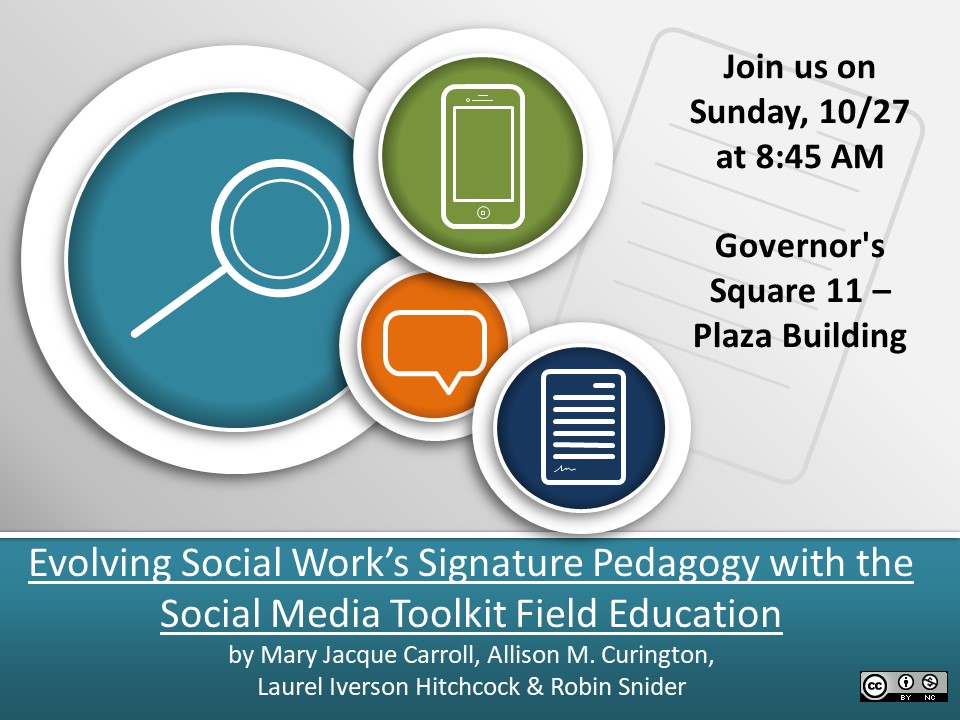
On October 27, 2019 at 8:45 AM, during the Annual Program Meeting for the Council on Social Work Education in Denver CO, Mary Jacque Carroll, Allison M. Curington, Robyn V. Snider and I will be presenting on information and tools that field directors can use to guide curricular development and assessment strategies around interprofessional communication with digital and social technologies. If you are still in Denver, please come find us in Governor’s Square 11 – Plaza Building of the conference hotel. We’ll also be sharing how you can develop your own professional social media policies to support communication with students and field agencies as well as how to create activities for students in field to increase understanding of the ethical use of social and digital media in social work practice.
You’ll also learn how to access the Social Media Toolkit for Field Educators, a free resource with educator’s guide and a PowerPoint slide deck.
#APM19 – Changing Teaching Practices for Technology: Using the SAMR Model for Technology Integration
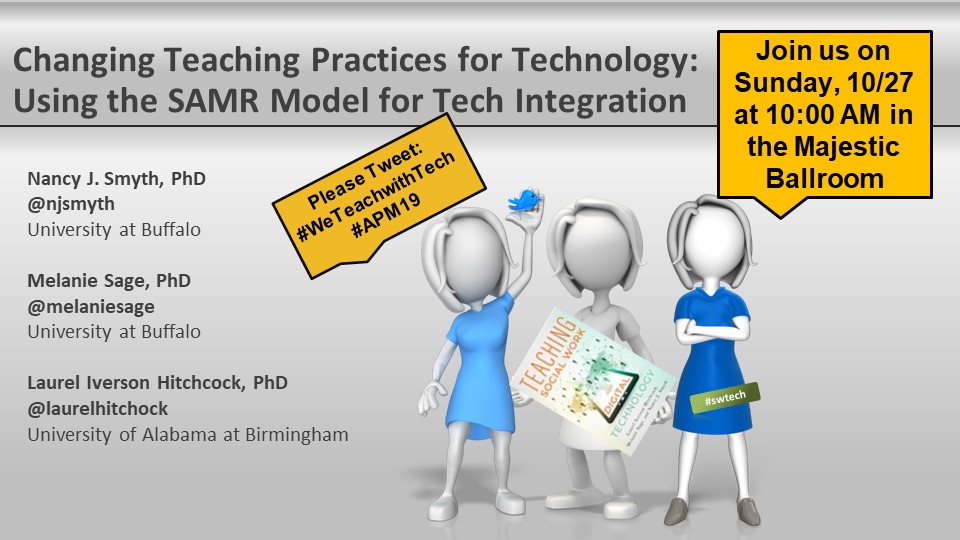
On October 27, 2019 at 10:00 AM, during the Annual Program Meeting for the Council on Social Work Education in Denver CO, Melanie Sage and I will be sharing some insights from Chapter 4 of our book, Teaching Social Work with Digital Technology, co-written with Nancy Smyth. If you are still in Denver, please come find us in the Majestic Ballroom –Tower Building of the conference hotel. We will be sharing how Puentedura’s SAMR Model for Technology Integration can be used to incorporate technology into traditional social justice assignments in social work education. There will also be time to adopt one of your current assignments using the SMAR Model.
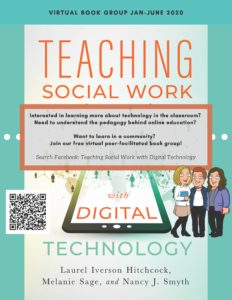
Additionally, we’ll be talking about our virtual book group that will be launch in January 2020. You can read more about it here:
For those of you who cannot make the presentation, we are including the details in this blog post.
Teaching Social Work with Digital Technology Book Group
If you teach social work with technology, either online or in a traditional classroom, we (Melanie, Nancy and Laurel) invite you to learn with and from peers in this free book group – Teaching Social Work with Digital Technology. Goals of this virtual book group are to: 1) create a supportive learning community; and 2) provide space for reflection about one’s own professional development with teaching with technology.
This group will run from January to June 2020, with monthly meetings and a moderated online private Facebook group. The group will include live virtual meetings, with discussion moderated by an author and a guest educator. In between meetings, social work educators will lead and moderate book discussions, and offer reflective questions and simple learning tasks. Participants should have access to the book by January 2020. The schedule follows:
Three Ways to Model Good Boundaries with Technology in Social Work Ed

The National Association of Social Workers’ (NASW) Standards for Technology in Social Work Practice (2017) offer a number of standards for social work educators and practitioners. One of these standards focuses on maintaining boundaries with our students. This is not a new ethical practice for social work educators; we have always worked to maintain boundaries with our students. Rather, the challenge has been navigating these boundaries in virtual spaces as technology has changed when and how we can communicate and engage with each other.
Not surprisingly, the tech standard from NASW focuses on the social work educator taking precautions. Managing risk is a good idea, and I would suggest that we also embrace the affordances that digital and social technologies can offer our students, our classrooms and our own professional development. The big question for most of us is how to do this in ways that are comfortable, manageable, and ethical. Over the past few years, many social work educators have contributed their knowledge and expertise to this blog about how they engage students around technology in their classrooms. In this post, I have pulled together some of their suggestions for how you can model good boundaries with technology in your teaching practice.

Teaching & Learning in Social Work by Laurel Iverson Hitchcock is licensed under a Creative Commons Attribution-NonCommercial-ShareAlike 4.0 International License