Review of Teaching & Learning in Social Work for 2018
One of the reasons I like a good “end-of-the-year list” is the opportunity to reflect on what I did and did not miss out on over the past year. I’m always thrilled to discover I read one or maybe even two of the most notable books on the New York Times yearly list. Then, I start planning my reading wish list for the coming year, which usually involves magical thinking about reading every winner of the Nobel Prize for Literature or the all the Pulitzer Prize winners for Non-Fiction from the last ten years. Even if I don’t actually read all of these books, I believe in having some goals for my reading and other activities. For the Teaching and Learning in Social Work Blog, I had three goals for 2018:
1 .Write or publish 30 blog posts
2. Increase the number of blog subscribers from 100 to 200
3. Publish 10 guest educator blog posts
Here is how those goals worked out:
1. Wrote only 13 blog posts during the year, but published a total of 21 posts (70% completed)
2. Only added 40 more subscribers to the blog (40% completed)
3. Published 8 guest educators posts (80% completed)
While not all my goals were achieved, I was still able to collaborate with others to accomplish some solid writing for the blog including information about projects that I have been working on, and all my conference presentations for the year. Below is a list of this year’s posts, grouped around the topics of projects, guest educator posts, and conference presentations.
Projects: These posts describe new projects that I started or worked on during 2018:
Using an Interprofessional Perspective for NASW’s Technology Standard for Social Work Education
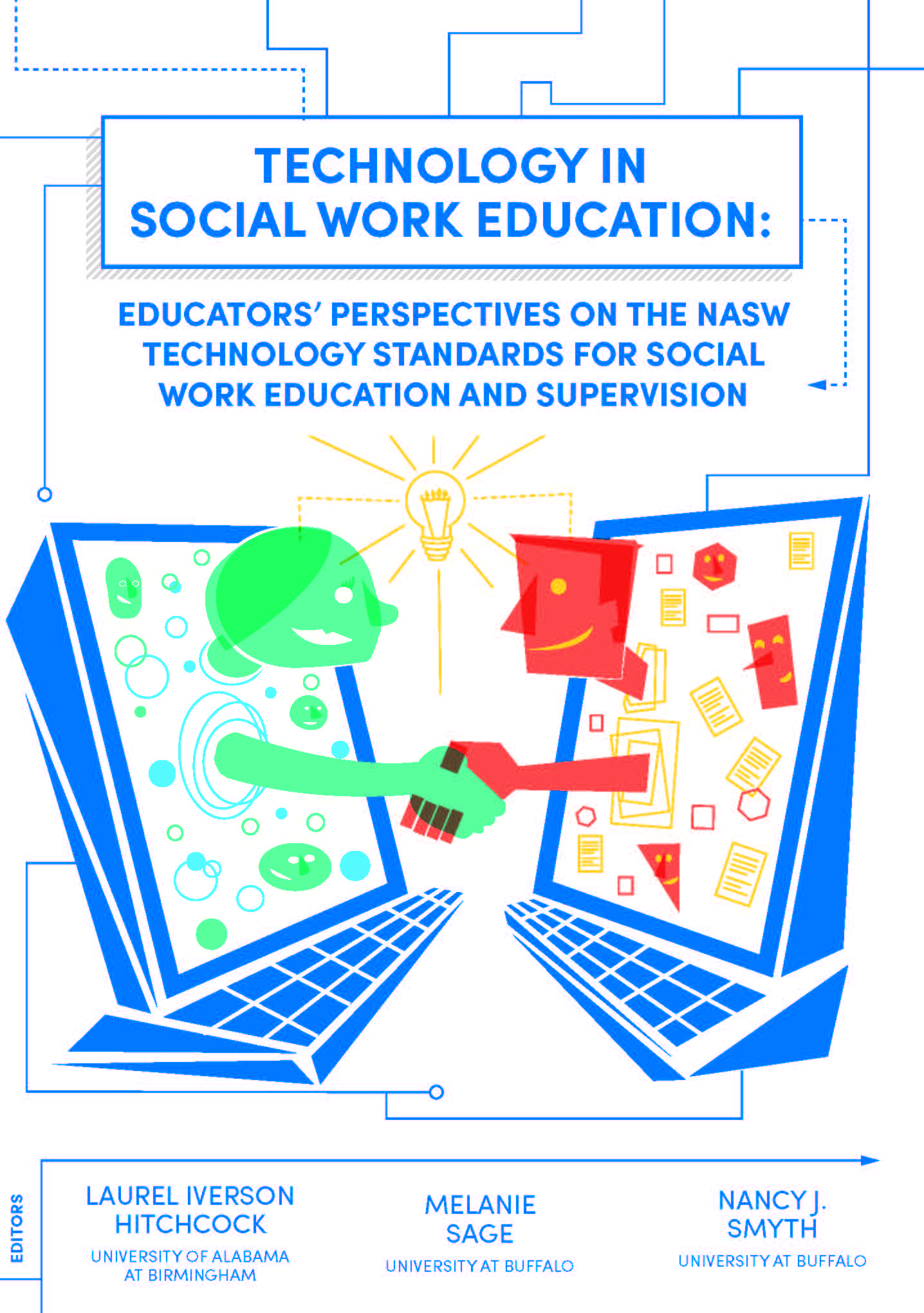 On Saturday, November 10, 2018 at 7:30 am in Dolphin, Walt Disney World Resort, Asia 3, Lobby/Third Level, I will be presenting with Drs. Melanie Sage and Nancy J. Smyth about our crowd sourced work, Social Work Educators’ Perspectives on NASW’s Technology Standard for Education, Training, and Supervision. We will be distributing printed copies of our booklet and sharing how social work educators can bring an interprofessional perspective to teaching with technology.
In 2017, new Standards for Technology in Social Work Practice were issued by NASW (and written in conjunction with CSWA, CSWE, and ASWB) to address the intersections of social work practice and technology. One of the standards (standard 4) focuses on technology for social work education, training, and supervision, while the other standards focus on the use of technology in social work practice.
After the standards came out, social work educators told us they wanted more information about how to actually use the guidance from the standards in their classrooms and universities. We (Laurel Hitchcock, Melanie Sage, and Nancy Smyth) reached out to social work educators and supervisors who have specialized knowledge of teaching and supervision with technology to provide more information related to interpretations. We used Google Docs to create a place for contributors to share their comments for how the educational standards should look in practice, the best practices related to standards, and the ways educators and supervisors can aspire to best practices related to technology. Then, we edited the ideas and comments by all the contributors into a cohesive document to provide guidance for educators.
To help disseminate this work, the University at Buffalo’s School of Social Work agreed to publish it as a booklet, and we distributed this for the first time in at the 2018 Social Work Distance Education Conference in San Antonio, TX.
Here you will find a link to the digital copy of crowd-sourced technology standards: https://tinyurl.com/SWEdTechStandards
You can access a copy of presentation slides here: https://drive.google.com/file/d/17MUD49n79hkwzlqcq20cvtt5IZJc9Rge/view?usp=sharing
Here is our conference proposal with learning objectives:
By the end of the session, participants will:
#APM18 Teaching with Technology using the SAMR Model
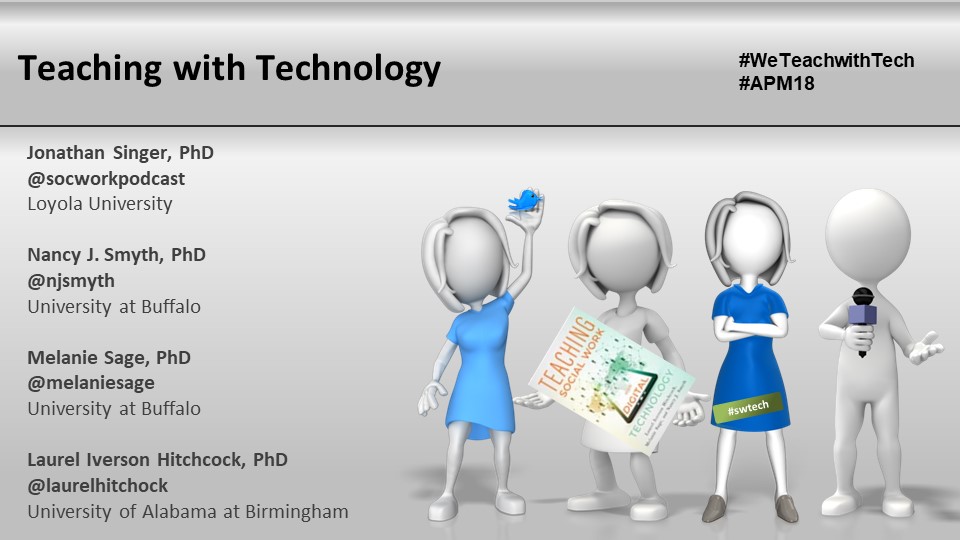 On Thursday, November 8, 2018, I will be presenting with Jonathan Singer, Melanie Sage & Nancy J. Smyth the Teaching Institute for Early Career Faculty at the Council on Social Work Education’s 2018 Annual Program Meeting. In this session, we are focusing on how faculty can incorporate technology into a social work course. All educators, especially those early in their careers, find themselves teaching from syllabi they had no role in developing. Although there are many benefits to the “hand-me-down” syllabus, one of the limitations is that assignments are rarely updated to reflect the realities of the 21st century workplace, which now includes the use of technology to achieve practice outcomes for clients and organizations. The purpose of this workshop is to learn about how to incorporate the use technology into a social work assignment on your syllabus, using Puentedura’s SAMR Module for Technology Integration. We will provide a brief overview of teaching with technology before focusing on how to infuse technology into an assignment from your syllabus, including learning objectives and associated assessment techniques in your syllabus. Participants will learn to identify ways to substitute, augment, modify or redefine existing learning strategies and assignments with technology-mediated learning strategies and assignments. By the end of the session, the participant will have an assignment that uses technology to meet the learning needs identified in the syllabus.
BPD Technology Committee’s Technology Assessment Checklist for Social Work Practice
Editor’s Note: This blog post was written by myself and my colleague, Dr. Nathalie P. Jones. We have been the co-chairs of the BPD Technology Committee for the past two-years (2017-2019) and served as editors for the Technology Assessment Checklist described and shared in this post.
In response to the growing influence of technology in the lives of individuals and families, the Technology Committee for the Association of Baccalaureate Social Work Program Directors (BPD) has created the Technology Assessment Checklist for Social Work Practice. This tool is designed to help social workers assess clients’ relationships and comfort with technology, including strengths, needs, risks, and challenges. This blog post describes the process used by the BPD Technology Committee to create this list as well as providing a description.
History of the BPD Technology Assessment Checklist
At the 2016 Annual Conference in Dallas, TX, the BPD Technology Committee embarked on a project to help create an assessment tool for social work practitioners and educators related to digital and social technologies. The goal was for the committee members, and others who were interested in the project, to work collaboratively to develop questions that could be used with individuals and families for the purposes of assessing clients’ use and relationships with digital and social technology. After the meeting, a call was put out on the BPD Listserv and a group of ten social workers agreed to assist with creating a technology-based assessment.
#husITa18/#SWSD2018: Sustaining lifelong learning through the use of Technology-Mediated Professional Learning Networks
On Friday July 6, 2018 at 3:15 PM in the Exhibition Hall at the 2018 International Social Work, Education & Social Development Conference, Melanie Sage, Nancy J. Smyth, Jonathan Singer, and I are presenting a poster about how social workers can use technology for career-long learning, specifically by creating a Professional Learning Network (PLN).
Simply stated, PLNs employ, within an online environment, the same strategy that social work professionals have used for centuries: the practice of connecting to people who share interests and can learn from each other. PLNs are a well-established practice in the field of education (Richardson & Manacebelli, 2011). The term comes from the educational technology learning communities and has its origins in Connectivism, a learning theory developed by George Siemens (2005) to explain how network-based learning occurs in the digital age. Specifically, Connectivism suggests that learning is the process of connecting sources of information together across networks, shifting learning from an individual process to a community effort. Thus, learning includes the skills of managing the flow of information, determining what is and is not useful information, and maintaining connections with others to facilitate on-going learning (Siemens, 2005). All of these skills are developed and applied with a PLN.
We are all big fans of PLNs, and have been sharing the practice with the social work community in the US for over a year now. Nancy, Melanie and I introduced the idea of professional learning networks (PLN) to a packed room of social workers at Social Work Distance Education Conference in April 2017, and have highlighted the practice in our upcoming book with Council on Social Work Education (CSWE) Press – Teaching Social Work with Digital Technology. In October 2017, the three of us along with Jonathan shared tips and tricks for setting up a PLN at CSWE’s Annual Program Meeting. Finally, Melanie and I wrote an article for Social Work Today about PLNs was published in March.
All of us also have our own PLN that we actively employ and nurture for our own professional learning. In the following, we each describe our own PLN:
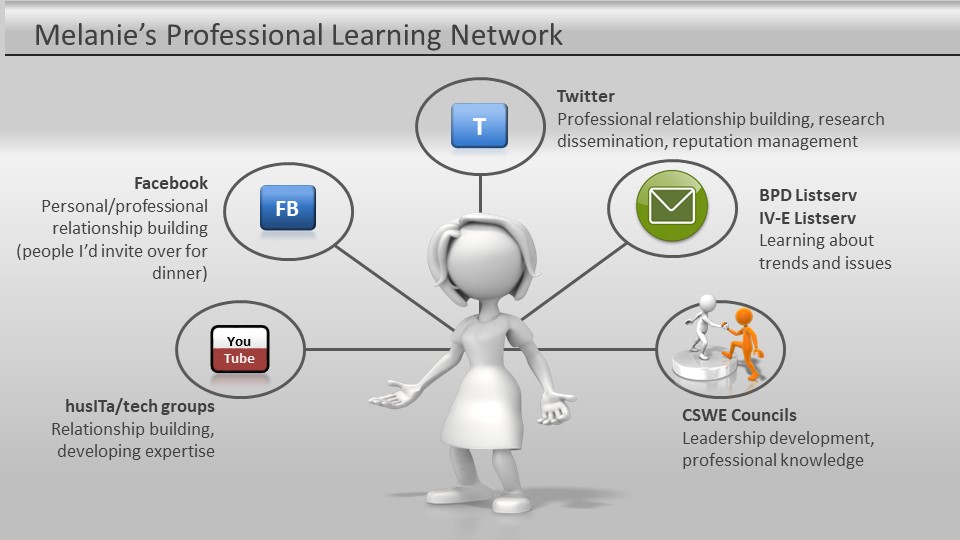 Melanie’s PLN: My goal is to build professional relationships around my scholarships interests, and to model positive technology – use for my peers. My PLN includes:
– husITa and other technology groups: I am a board member of husITa and active with other tech groups. I follow all of them via different social media platforms and share links to technology related content.
– Facebook: I participate in several closed professional social work & technology groups on Facebook for professional reasons, but I mostly use FB to deepen my connections with colleagues and friends.
– Twitter: This is my go-to-app for initial networking as it is easy to find people, quickly learn about their interests, and engage with short posts (under 240 characters).
– Listservs: I belong to several email-based listservs where I can learn about trends and share my own research.
– CSWE Councils: I am a member of a CSWE Council and here is where I work to connect my in-person network with my digital network, by talking to others about how leaders can use social media to connect and share information.

Teaching & Learning in Social Work by Laurel Iverson Hitchcock is licensed under a Creative Commons Attribution-NonCommercial-ShareAlike 4.0 International License