What Social Workers are saying about the NASW Draft Tech Standards?
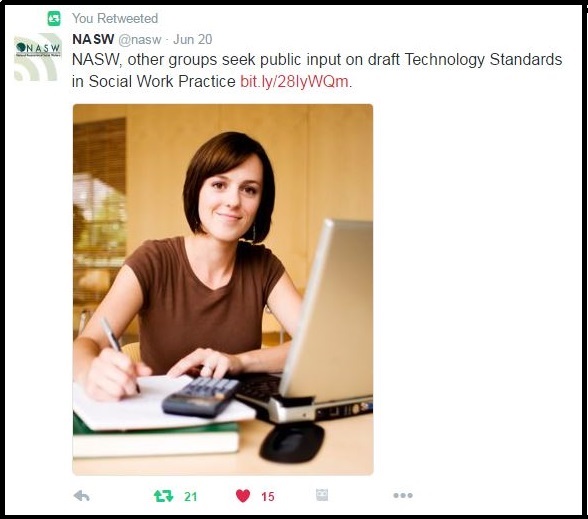 On June 20, 2016, the National Association of Social Workers along with Association of Social Work Boards, Council on Social Work Education and the Clinical Social Work Association released a draft copy of proposed new practice standards for technology in social work, and invited the public to comment and provide feedback. If you want to know what I did on my summer vacation this year, this was it! I worked with four different groups to draft comments, submitted my own comments, and advocated for all social workers to read and respond to NASW’s call for comments.
Feedback was due on July 20th, and now we wait for NASW and the other groups to respond, revise and/or release the final standards. Until then, I think there is value in sharing the comments and responses that were submitted to NASW. I have asked permission from a variety of individuals and groups to post their comments in this blog post. This is not a comprehensive list, but reflects the opinions of people and groups that I work with or know. Also, there is no particular order to the list; one set of comments is not more important than another set. Click on the links in the list to access a particular individual or groups’ comments. If you would like to add your feedback to this list, please contact me.
List of Comments to NASW’s Draft Tech Standards
– Technology Track for the Annual Program Meeting of Council on Social Work Education and Technology Committee of the Association of Baccalaureate Social Work Program Directors – These two committees combined their efforts and wrote one set of comments. I am a member of both committees.
– Dr. Robert Vernon is a Professor at Indiana University’s School of Social Work and is a pioneer in the use of technology in social work. His comments are available here.
Social Work Scholarship in the Age of Social Media
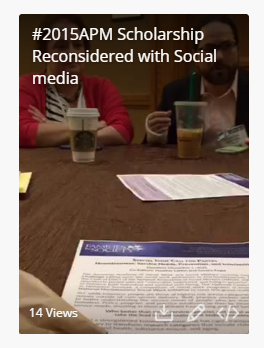 It has been almost two months since the Council on Social Work Education’s Annual Program Meeting in Denver this past October (#APM2015), and I have been thinking a lot about one of the round table discussions I attended. The topic was “Blogs, Podcasts, and Tweets: Reconsidering Scholarship in the Age of Social Media” and the conversation was led by Jonathan Singer of the School of Social Work at Loyola University and Nancy J. Smyth of School of Social Work at the University at Buffalo. Its purpose was to engage participants in a dialogue about the ways social media are changing how social work educators and scholars think about, produce, disseminate and measure the outcomes of scholarship in social work. I recorded the discussion with Periscope, a video recording app for Twitter, and you can watch the video here. Be warned – the discussion started at 7:30 AM, requiring me to juggle my mobile phone with a large cappuccino.
There were about twenty other people present, representing all areas of social work academia (tenured and nontenured; administrators, researchers and teachers; large research institutions to small liberal arts colleges). Here are just some of the questions or concerns mentioned during this discussion:
– How can digital content (blog posts, tweets, podcasts) be incorporated into the tenure and promotion process?
– What is the best way to share ideas about scholarship via social media? Will it get scooped?
– How do we ensure a level of quality with social work scholarship that is published via social media?
I am not sure any of us walked away from the discussion with the answers to all our questions, but I believe the consensus was that social and digital media are powerful tools for sharing and discussing social work scholarship. To be clear, I’m not arguing that social and digital media will replace the traditional forms of social work scholarship such as journals, books and conference presentations. I know that writing this blog will not get me tenure, but it does provide me with different ways to connect with other scholars, share ideas and write about topics that don’t fit into traditional publication avenues. Social media provide vital and rich ways to share, curate and discuss practice and research in social work. I am convinced that today’s social work faculty need to become savvy enough to share and discuss social work scholarship in digital environments. Here are my three reasons for using social media as part of my scholarship:
Podcasting for Social Work Students, Part 3 – Advice for designing the assignment from Jonathan Singer
 One of the experts in social work podcasting is Jonathan Singer who runs the Social Work Podcast. He has been podcasting since 2007, and the goal of his work is to disseminate research by and for social workers to improve their practice and outcomes for clients. I spoke with Jonathan about his thoughts on working with students to develop their own podcasts and he recommended educators considering the following three points as they develop podcast assignments:


Teaching & Learning in Social Work by Laurel Iverson Hitchcock is licensed under a Creative Commons Attribution-NonCommercial-ShareAlike 4.0 International License