Book Group Discussion Guide for Teaching Social Work with Digital Technology

Back in September, Melanie Sage, Nancy Smyth, and I announced a virtual book group for our work – Teaching Social Work with Digital Technology. The goals of the book group were to: 1) create a supportive learning community; and 2) provide space for reflection about one’s own professional development with teaching with technology. You can read more about this blog post:
Teaching Social Work with Digital Technology Book Group
We launched our book group in January and ended it in June 2020, with monthly meetings and a moderated online private Facebook group. The group included a monthly live virtual meeting with discussion moderated by the authors and guest facilitators. Live meetings allowed members to participate and ask questions. In between these live meetings, the facilitators led and moderated discussions about teaching with tech, offering reflective questions and simple learning tasks. Additionally, all live meetings were recorded and archived for later viewing in the group. We will leave the group up as an archive until the end of 2020. Please know that this group will no longer be moderated.
Overall, we had a total of 223 members in the group, and based on the group analytics there were over two hundred posts submitted, and a lot more members reviewing/reading the posts. Although we expected greater engagement, we know that this year brought unexpected challenges for all of us. We believe that good discussion prompts and questions from our facilitators promoted thoughtful reflection and engagement each month. We are sharing these questions and prompts here in this blog post so that others can use them for their own review or to start book groups in their institutions. Here is the discussion guide:
Review of Teaching & Learning in Social Work for 2019

It is that time of year again – the annual review of the Teaching & Learning in Social Work Blog. This will be my fourth year reflecting on the work of this blog; the first end of the year post was in 2016. This year, I am thinking more about my motivation for starting and maintaining this blog for the past seven years. As I think back on why I started Teaching & Learning in Social Work, I’d have to say I wanted to be a more confident writer. Academic writing is not easy. This blog helped me to find my academic voice while allowing me to experiment with writing. I try to be personable in the posts I write, using plain language and concise phrasing. While I can say I am more comfortable with my professional writing, the greatest benefit to this blog is having space to share my work and the work of others in a very non-traditional space. Publishing is a peer-reviewed journal is currency for academics, and it is a narrow, rigid, and polished way to share one’s work. By writing blog posts about my work early in the process, I can share with a wider audience including students, social work practitioners and professionals from other fields. I can also as publish work that may never find a home as a journal article, but is still of value to others. For example, I write frequently about my assignments and classroom activities on this blog. I also post information about my conference presentations here so others can easily reference the materials. Overall, I can say with confidence that writing and publishing Teaching & Learning in Social Work has truly be beneficial and motivating for my academic writing.
For 2019, I had three goals for improving the blog:
#SWTech – An Introduction and History of the Online Group
Editor’s Note: This blog post was written by the following users of the #SWTech Community – Melanie Sage, Assistant Professor of Social Work at the University at Buffalo; Laurel Iverson Hitchcock, Associate Professor of Social Work at the University of Alabama at Birmingham: Jonathan B. Singer, Associate Professor of Social Work at Loyola University and founder of the Social Work Podcast; and Nancy J. Smyth, Professor & Dean at the School of Social Work at the University at Buffalo.
This is an introduction to #SWTech, an online network of social workers interested and engaged with technology for social good. Our goal is to help individuals new to #SWTech learn about the norms, history, and general merrymaking within the community. This statement can also service as a resource to send people who are interested in learning more about #SWTech.
Description
#SWTech is a hashtag used by people and groups interested in the intersection of social work and technology. People use #swtech primarily on Twitter, but the hashtag is occasionally used on other social media platforms such as Facebook or Instagram. This hashtag is used in tweets and other posts on social media to share about such topics as:
#SWTech: The Beginnings of an Online Community
In just a few days, Google will eliminate its online community platform, Google+, and with it will go the first iteration of our #SWTech Online Community. This has me thinking about the whys and whats of how our #SWTech community started and developed, and how it will soon evolve. This blog post is my first attempt to chronicle the people and platforms that shaped our community. My methods were simple. I sent emails to some members requesting information, and talked over the phone and video calls with others. I readily acknowledge the bias and poor memory that I bring to this brief and simple historical record. In fact, this was a common theme I heard from others. I think Neil Ballantyne, Senior Lecturer at Open Polytechnic of New Zealand and board member of husITa, said it best when I asked him how he discovered the #SWTech group:
#APM18 Teaching with Technology using the SAMR Model
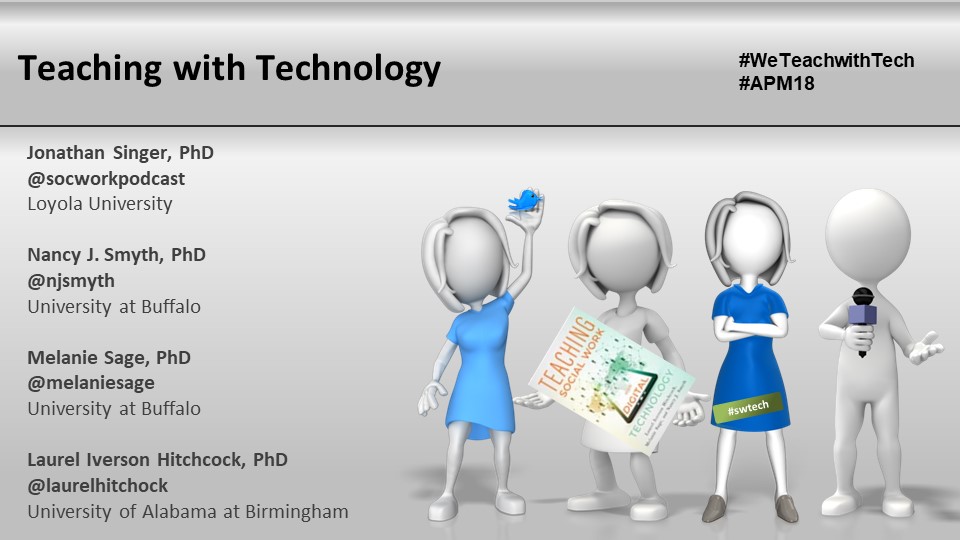 On Thursday, November 8, 2018, I will be presenting with Jonathan Singer, Melanie Sage & Nancy J. Smyth the Teaching Institute for Early Career Faculty at the Council on Social Work Education’s 2018 Annual Program Meeting. In this session, we are focusing on how faculty can incorporate technology into a social work course. All educators, especially those early in their careers, find themselves teaching from syllabi they had no role in developing. Although there are many benefits to the “hand-me-down” syllabus, one of the limitations is that assignments are rarely updated to reflect the realities of the 21st century workplace, which now includes the use of technology to achieve practice outcomes for clients and organizations. The purpose of this workshop is to learn about how to incorporate the use technology into a social work assignment on your syllabus, using Puentedura’s SAMR Module for Technology Integration. We will provide a brief overview of teaching with technology before focusing on how to infuse technology into an assignment from your syllabus, including learning objectives and associated assessment techniques in your syllabus. Participants will learn to identify ways to substitute, augment, modify or redefine existing learning strategies and assignments with technology-mediated learning strategies and assignments. By the end of the session, the participant will have an assignment that uses technology to meet the learning needs identified in the syllabus.


Teaching & Learning in Social Work by Laurel Iverson Hitchcock is licensed under a Creative Commons Attribution-NonCommercial-ShareAlike 4.0 International License