Review of Teaching & Learning in Social Work Blog Posts for 2016
 The end of a year is a natural time for reflection, and this year I offer a review of all the posts that appeared on Teaching & Learning in Social Work Education during 2016. My goal for this blog is to write or publish at least two posts a month, which happened more months than not. I also recruited other social work educators to write about their own experiences in the classroom or with scholarship, and also write about about all of my presentations, either at conferences or as a part of a workshop. This year, I published a total of 25 blog posts, representing work with numerous collaborators and good colleagues. Below is a list of this year’s post grouped around the topics of assignments, projects, guest educator posts, and conference presentations.
Assignments: These blog posts provide information, how-to tips, and ideas about different types of technology-based assignments for the social work classroom:
– Job Shadowing on Twitter with Joy Jones on 1/8/16
– Tweet, Tweet!: Using Live Twitter Chats in Social Work on Education with Dr. Jimmy Young on 1/29/16
– Using #MacroSW in the Classroom with the @OfficialMacroSW Partners on 3/14/16
– Using Pinterest in Undergraduate Social Work Education – #BPDTX16 with Dr. Lisa Baker on 3/31/16
– Revised Technology-Based Learning Task List for Social Work Education with Drs. Melanie Sage and Nancy J. Smyth on 6/13/16
Social Media How-To Guide for Social Work Educators
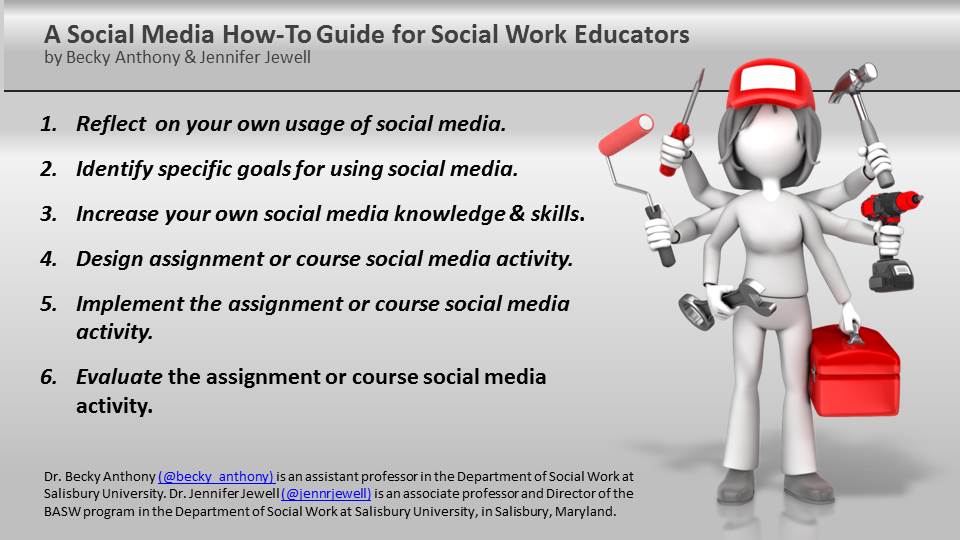 This post was written by Drs. Becky Anthony and Jennifer Jewell. Dr. Becky Anthony (@becky_anthony) is an assistant professor in the Department of Social Work at Salisbury University. Dr. Jennifer Jewell (@jennrjewell) is an associate professor and Director of the BASW program in the Department of Social Work at Salisbury University, in Salisbury, Maryland. In this blog post, they write a guide for how social work educators can best utilize social media to meet their educational goals.
With the changing nature of educational delivery and knowledge consumption, social work educators are increasingly utilizing social media to help students meet course learning goals and objectives. Students are able to use social media to network with social work professionals, enhance connections between peers, advocate and raise awareness about social concerns, and find resources that help them practice effective social work (Jewell & Anthony, 2016). Some social work educators want to utilize social media in their courses to help students meet learning goals, but are unsure about how to get started. This blog post reviews steps to help social work educators prepare and implement social media assignments and activities into the classroom.
STEP 1: Think about and reflect on your own usage of social media. You need to determine what you will do to abide by professional ethical standards, maintain your own personal boundaries, and explore how you will utilize social media. In this first step, you will create social media guidelines for the course, the department, and/or the professional self. Laurel Hitchcock provides an effective and thorough example of that here: My Guidelines for using Digital and Social Tech in the Classroom and Beyond. This first step allows you to learn about your own professional usage of social media and your own personal boundaries and professional ethics.
STEP 2: Identify specific goals for using social media in this course or with this specific assignment. Once goals are established, you will need to research the different tools (specific social media platforms). For example, Instagram is utilized to share photos and videos and Twitter only allows for 140 characters in each post. Social work educators, during step two, should answer the following questions: 1. What do you want the students to learn? 2. What social media method will work best to achieve this goal?
STEP 3: Increase your own social media knowledge and skills. Specifically, focus on the social media platform you will utilize in your course. You will find it helpful to create an account (if you do not already have one), watch tutorial videos online, utilize tip guides, and practice using this social media before asking your students to use it. This becomes very important because a number of students will not have previously utilized this social media platform and will ask you questions about how to get started and where to find resources.


Teaching & Learning in Social Work by Laurel Iverson Hitchcock is licensed under a Creative Commons Attribution-NonCommercial-ShareAlike 4.0 International License