Teaching Technology-Mediated Practice in a Clinical MSW Program
 Janet Vizina-Roubal, DSW, MSW, is an Associate Professor of Social Work at Ferris State University in the Department of Social Work. In this blog post, she writes about her inspiration for a technology-mediated practice assignment with MSW students. Assignments like this one will be increasingly valuable for social work students preparing to use technology with clients while meeting professional and ethical practice standards such as the NASW Code of Ethics and the NASW, ABSW, CSWE & ACSW Standards for Technology in Social Work Practice. If you have questions about the assignment, you can reach Dr. Vizina-Roubal on Twitter at @jvizina.
I started teaching my first clinical MSW course the fall of 2014 with excitement and nervousness. With almost eight years of clinical experience in school social work and outpatient therapy, I had a great toolbox of practice tips to share with my students. Adding to the excitement was the idea of creating a technology-based assignment where students could learn and practice technology-enhanced therapy skills. Because I had completed and presented research with a colleague about the benefits of using iPhones in child welfare work, I was curious about how I could create a technology-based assignment for MSW social work students.
Clinical MSW social work classes typically rely on a vast amount of face-to-face role-plays, requiring students to play the part of client and social worker. This experiential learning is challenging, however is very effective at teaching students critical clinical skills. I was interested in stretching this experiential learning process into role-plays for a technology-mediated learning environment, with the goal of helping students learn how to engage with clients via technology-based communication tools. Based on this idea, I worked to structure assignments that would allow students to learn how to use technology within clinical social work. As I embarked on this journey, I searched for curricula or assignments on how to teach online therapy along with best practices. Bewildered, I found almost nothing (Cardenas, Serrano, Flores, & De 2008). I did stumble upon research that showed promising findings that online therapy might be as effective as face-to-face therapy (Chester & Glass, 2006; Dowling & Rickwood, 2013; Holmes & Foster, 2012). This finding legitimized my interest in pursuing this course of instruction and compelled me to develop assignments where students gained experience within online therapy; practicing as the client as well as the therapist.
Join the Convo – NASW needs feedback on Draft Technology Standards in SW
 I am so pleased that the draft Technology Standards for Social Work Practice have been released for public review. NASW, CSWE, CSWA, and ASWB developed a task force to collaboratively draft these technology standards, which you can access the draft standards here.
I am working with several groups to provide comments to the task force and, I also plan to submit my own comments. Once adopted, these standards will be considered a model for best practice in social work. Given the important legal and ethical role that practice standards have in the professional lives of social workers, I believe it is essential to offer constructive and timely feedback on this document. I want to encourage everyone in the social work community to review and submit their feedback. You do not need to be a member of any group to offer feedback. The timeline is short for submitting comments – the one-month comment period closes July 20th.
Here are some highlights about the document. The draft standards and their interpretations are 82 pages. If you do not want to read 82 pages, you may want to know that these standards cover the following:
- Section 1: Provision of Information to the Public
- Section 2: Designing and Delivering Services – Part A: Individuals, Families, and Groups and Part B: Communities, Organizations, Administration, and Policy
- Section 3: Gathering, Managing, and Storing Information
- Section 4: Communication with and about Clients
- Section 5: Social Work Education (especially distance education)
Revised Technology-Based Learning Task List for Social Work Education
 Back in April 2016, Melanie Sage, Nancy Smyth, and I first shared a list of technology-based learning activities that we developed based on Council on Social Work Education’s Social Work Competencies from the 2015 Educational Policy and Accreditation Standards (EPAS). The purpose of this list is to help social educators infuse learning about and with technology across the social work curriculum. We have updated our list to keep with the evolving understanding of how to apply CSWE’s 2015 EPAS. Here are the main features of the list:
– Over 100 different example assignments and learning tasks with brief directions that can be incorporated into social work courses across the curriculum.
– Assignments are designed to encourage students to share their work with a class/seminar or practicum field instructor.
– For assessment purposes, each assignment and learning task is grouped by competency and component behaviors, and then labelled with the relevant competency dimensions using the following key: K = Knowledge; V=Values; S= Skills; and CA = Cognitive and Affective Processes.
You can access the new version of the list here: Technology-Based Learning Task List for Social Work Education (Version 1.1 – 6/13/16)
#APM2015 Using Documentaries and Twitter to Meet Macro/Policy Objectives in Social Work Education
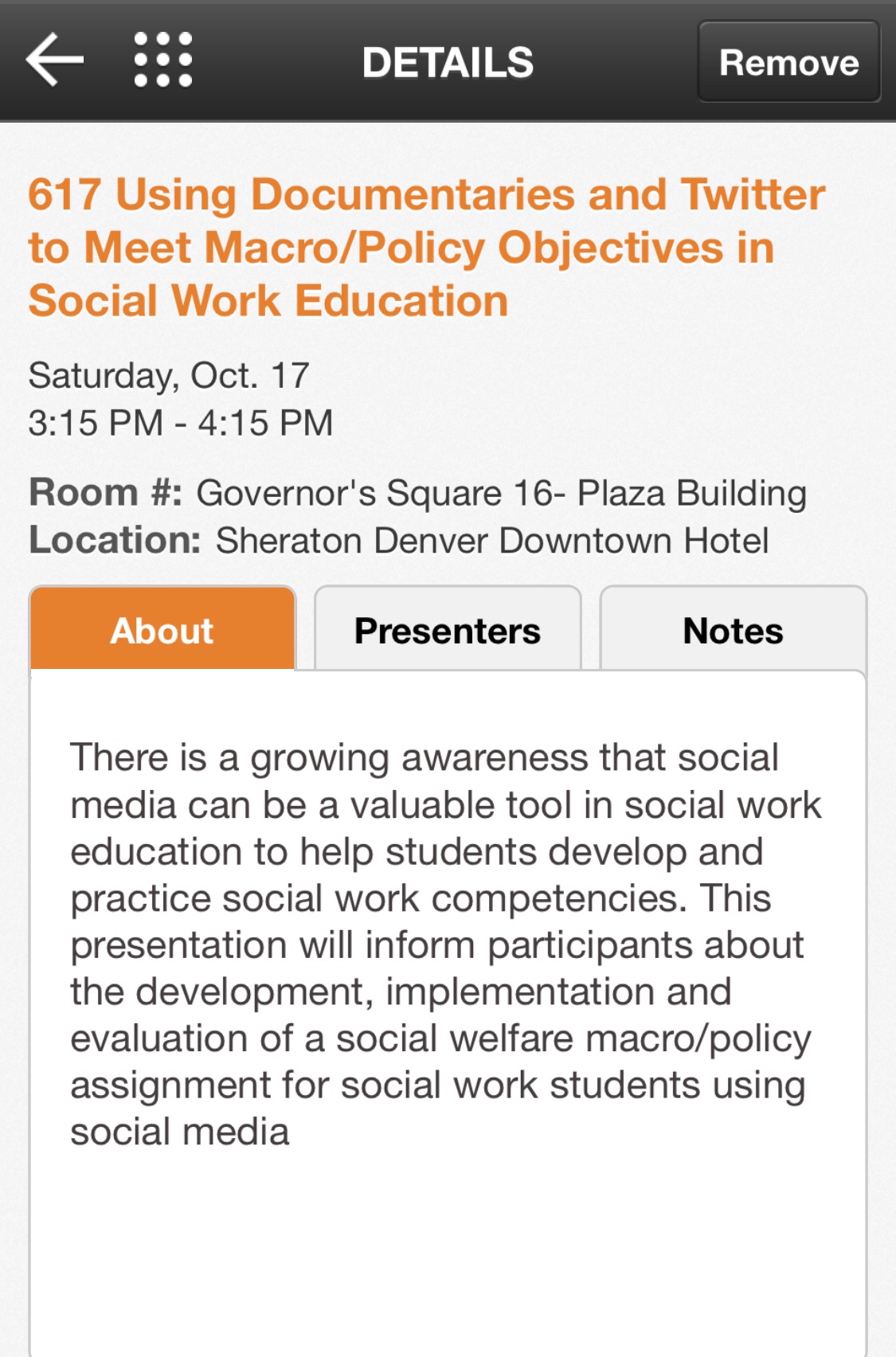
 Today, Dr. Jimmy Young and I are presenting at the 61st Annual Program Meeting of the Council on Social Work Education about our social media assignment using a documentary movie and Twitter. There is a growing awareness that social media can be a valuable tool in social work education to help students develop and practice social work competencies. This presentation will inform participants about the development, implementation and evaluation of a social welfare macro/policy assignment for social work students using social media. In our session, we will The learning objectives for this session include:
1. Understand how the social media platform Twitter can be incorporated into assignments for social work policy and macro courses.
2. Demonstrate how social work educators can assess attainment of competency among social work students using a social media assignment paired with a Rubric for evaluation of the assignment’s learning outcomes.
3. Appreciate the role of professional collaboration in the development, implementation and evaluation of social media-based assignments.
Here is a link to the Prezi that we will show during the presentation.
Twitter Learning Activities for Social Work Competencies
Last month, Ellen Belluomini wrote a very practical and helpful blog post for social work field educators and students about technology-based activities that can be incorporated into a social work student’s learning plan for field education. I tip my hat to Ellen and am shamelessly borrowing her idea to present my own list of learning activities for each of the CSWE Social Work Competencies. My list focuses on using Twitter, a microblogging social media platform, as a tool for students to practice and demonstrate proficiency of social work skills, knowledge and values. As you may guess from my previous posts and research interests, I am a big fan of Twitter as a tool for professional social work practice. This list includes just some possibilities of tasks, assignments and readings all based on students using Twitter as part of a course. It is by no means a comprehensive list. What are some other ways you have used Twitter as part of your courses or as part of your social work practice? How have you used Twitter to enhance your own social work practice. Please share your ideas or thoughts.
|
CSWE Social Work Competency |
Classroom Tasks, Assignments and Readings |
|
Identify as a professional social worker and conduct oneself accordingly.
|
1. Create a free Twitter account and develop a public profile as a professional social worker. 2. Review the public profiles of practicing social workers, educators and/or students. Develop of list of common characteristics from these profiles, identifying any best practices or good model. 3. Review the tweets of practicing social workers, educators and/or students for examples of professional vs. unprofessional demeanor in communication. |
|
Apply social work ethical principles to guide professional practice.
|
1. Read Dr. Frederic Reamer’s article Developing A Social Media Ethics Policy. Write and post a tweet about the most important concept you learned from the article. 2. Write a brief one-paragraph social media policy for how one plans to use Twitter as a professional social work, including examples of what one will and will not include in their tweets. 2. Post tweets about the National Association of Social Worker’s Code of Ethics. For example, send out a tweet describing one of the six core values including a hyperlink to a source that represents the value. |
|
Apply critical thinking to inform and communicate professional judgments.
|
1. After each social work class, post a tweet about what you learned in the class. 2. Alternatively, after each class, post a tweet with a question that you have about the class content. 3. Create a public list on Twitter about a social problem or important social work topic, and follow at least 10 different groups or organizations. Provide a reason for why you included each group on your list. |
|
Engage diversity and difference in practice.
|
1. Create a public list or groups or organizations that focuses on an area of diversity and difference in practice such as a list of LGTB advocacy agencies or bloggers who write about aging in American society. 2. Search for new articles about an issue of diversity that is important to you and re-tweet with a comment. Consider focusing your tweet on how the article supports or does not support the dignity and worth of the person. 3. Read NASW’s Standards for Cultural Competence in Social Work Practice. Identify three ways you could use Twitter to develop culturally competent knowledge and skills as a social work student, and in the future as a social work practitioner. |
|
Advance human rights and social and economic justice.
|
1. Participate in a live Twitter Chat that addresses a social and/or economic justice issue such as the Mental Health Chat. 2. Create a public list of advocacy organizations on Twitter related to social or economic justice issues such as poverty or health care disparities. See my list on food insecurity as an example. 3. Watch a documentary movie on a social justice issue and send out tweets with hashtags about the movie, focusing on the movie’s message and important facts from the movie. See Dr. Jimmy Young’s blog post on twitter and documentaries for more details. |
|
Engage in research-informed practice and practice-informed research.
|
1. After reading a social work research article, write and post a tweet summarizing the article. 2. Create a public list of researchers interested in an important social work issues or social problem. 3. Read the blog post From Tweet to Blog Post to Peer-Reviewed Article: How to be a Scholar Now by Jessie Daniels. Identify ways Twitter could be used to answer important social work research questions. |
|
Apply knowledge of human behavior and the social environment.
|
1. Post tweets with links to different newspaper articles about topics relevant to HBSE. 2. Do a search with hashtags on Twitter about different developmental stages covered in your HBSE classes such as #aging or #childhood and read what others are tweeting. In a brief paragraph, identify different themes you discovered from the tweets and describe each one. 3. Go to the Pew Internet & American Life Project’s website and search for the most recent information about who is using Twitter in the US and why. Write a brief paragraph about what you learned. |
|
Engage in policy practice to advance social and economic well-being and to deliver effective social work services.
|
1. Identify a policy issue of interest to you and tweet a question about it to the local, state or federal government agency responsible for implementing the policy. 2. Create a public list of local politicians in your community, and share your list with others. 3. Write and post tweets about current social welfare policies using links to newspapers articles, policy research centers and other professional literature sources. |
|
Respond to contexts that shape practice.
|
1. Read Dr. Nancy J. Smyth’s blog post Twitter 101 to learn about Twitter. 2. Read the NASW & ABSW Standards for Technology and Social Work Practice. Identify examples of how these standard will influence social workers using Twitter for professional practice. 3. Participate in a live Twitter Chat about a social work topic that interests you. Write a brief paragraph about the experience and what you learned. |
|
Engage, assess, intervene, and evaluate with individuals, families, groups, organizations, and communities.
|
1. Create a public list of organizations that focus on one of the five different client systems. For example, a list about agencies or organizations that focus on small group work or practitioners who specialize in family therapy. 2. Write and post tweets about new research on interventions strategies used by social workers. Check out the Information for Practice website as resource for this activity. 3. Develop and moderate a live Twitter Chat about an important issue in your community or offer to host a live Twitter Chat for a local non-profit on a topic related to their mission. |
Twitter Learning Activities for Social Work Competencies
How to cite this post:
Hitchcock, L. I. (2013, December 18). Twitter Learning Activities for Social Work Competencies [Blog Post]. Retrieved from https://laureliversonhitchcock.org/2013/12/18/twitter-learning-activities-for-social-work-competencies/.


Teaching & Learning in Social Work by Laurel Iverson Hitchcock is licensed under a Creative Commons Attribution-NonCommercial-ShareAlike 4.0 International License