Three things I learned at #IPECSpring18
 About two weeks ago, I attended my fourth conference of the spring semester – the 2018 Spring Institute of the Interprofessional Education Collaborative (IPEC) held in Washington, DC from April 30 – May 2, 2018. As I was flying home, I tried to reflect on what I had learned at the IPEC Conference as compared to my other three conferences from the semester. Not surprisingly, I struggled to remember the names and even locations of the other three conferences, including one that I attended in mid-April. Even now as write this post in mid-May, my memories of the IPEC conference are fading. Given all the time, energy, and resources that goes into attending a conference, I wondered about what I was learning at all of these conferences, how it was informing my work as a social work educator; and how I might be able to utilize or share my learning with others.
A quick internet search turned up a few articles about the impact of academic conferences on scientific research, professional development of individual academics, and on disciplines as a whole. A blog post by Donald Nicolson, The last great unknown? The impact of academic conferences, offers a good answer to my own questions and proposed another – How do academic conferences make a difference in the lives of academics and wider society? The short answer is we really don’t know, especially in social work education and practice. Here is a ripe research opportunity for someone with more time and energy than me. I am not looking for another research project, so feel free to let your doctoral students know about this one. I did, however, come up with a solution to my challenge of integrating what I learned at conference into my professional life as a social work educator – I should blog about every conference. Not only will I able to reflect on my conference experiences through the process of writing, blogging also lets me share my thoughts with others adding value (hopefully) for those who couldn’t attend the conference or maybe are interested in a social worker’s perspective on a conference.
So how do I go about blogging about a conference? For a few years now, I have been posting information about my own conference presentations. My structure for these post is to take my original conference session proposal, add copies of the slides or handouts, and include some information about the conference and my co-presenters, and viola, a quick and easy blog post. Here is my most recent conference blog post from the third annual Social Work Distance Education Conference in April 2018. While this is a great way to re-use that conference proposal, these blog posts are not reflective of my own learning nor do they offer professional insight about a conference as a whole. To help me write about academic conferences I went back to the internet and I found this blog post, 12 ways to write a conference blog post by Alison Bolen. She her suggestions for blogging about conferences range from a simple summary of one’s impressions from the conference to sharing a to-do list of actions and ideas that you plan to pursue following the conference. Another of Bolen’s ideas is to discuss one’s personal lessons learned, which resonated with me as the IPEC Conference was all about new ideas for me. So without further ado, here are the three most valuable things I learned about Interprofessional Education (IPE) at #IPECSpring2018:
#BPD2018 Harnessing Technology for one’s own Good: Professional Learning Networks in Social Work
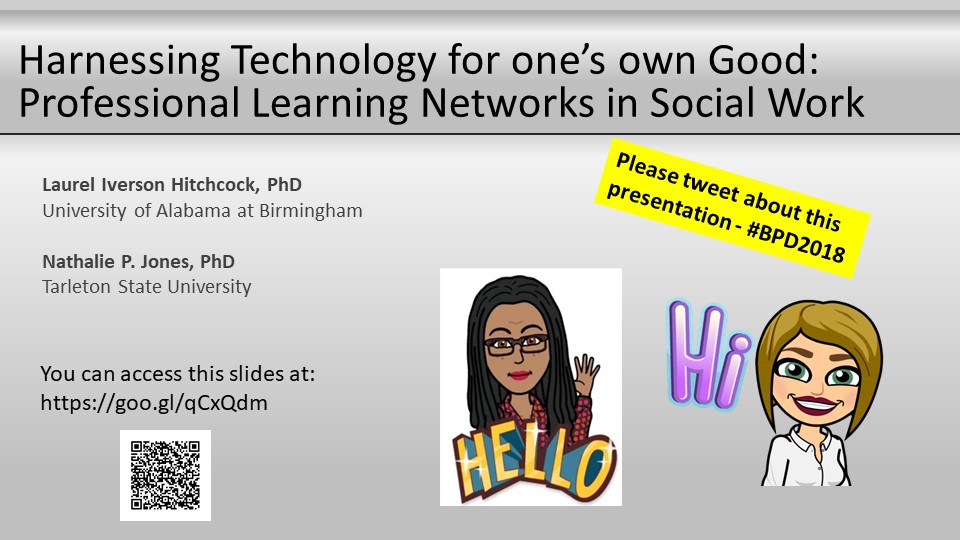 Today, Dr. Nathalie Jones and I will be presenting about Professional Learning Networks (PLNs) at the Association of Baccalaureate Social Work Program Directors in Atlanta, GA. This year’s theme is the Grand Challenges of Political Change, and we have been talking with our colleagues about how do we, as social workers, affect change in today’s political and social environments – change to improve the lives of vulnerable populations we serve; change to improve learning outcomes for our students; and change for ourselves as social work educators. Nathalie and I share a common desire to help other social work educators develop their own tool kits for teaching, scholarship, and service in their lives as academics, mentors, and partners with constituents and communities. One tool that we know works is having a Professional Learning Network, and we know this because it has worked for us – we met via Twitter using our PLNs. We have been working with our good colleagues – Drs. Melanie Sage and Nancy J. Smyth (both at the University at Buffalo) – to share what we know about PLNs to help raise awareness about this tool in social work education and practice.
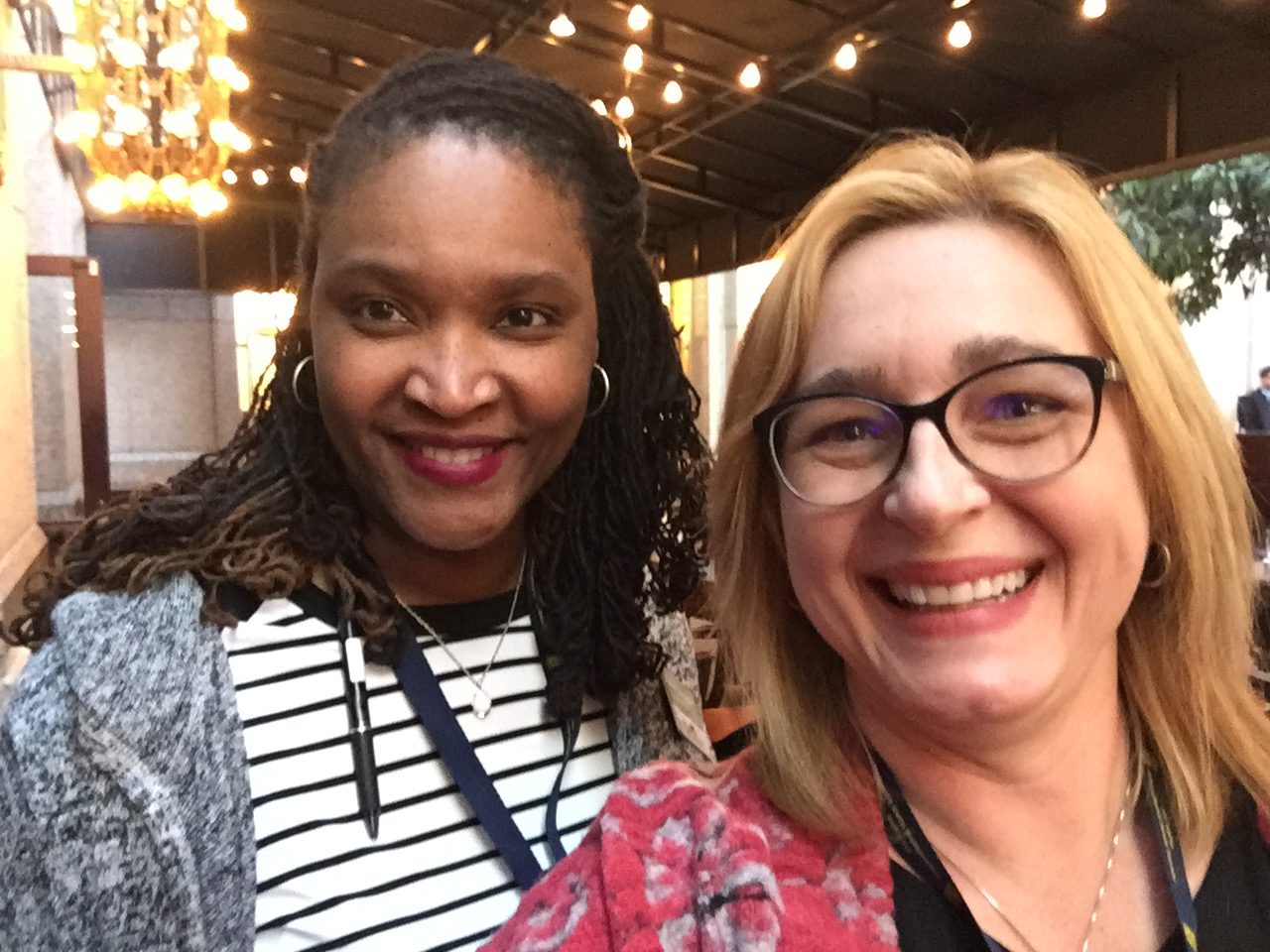
Nathalie Jones & Laurel Hitchcock’s #BPD2018 Official Conference Selfie
We hope you will join us at 1:45 PM in Georgia 2 in the Atlanta Sheraton. We will describe what what a PLN is and why to use one; demonstrate how to establish your own PLN and how to incorporate; and share how theory helps to inform the process of adopting technology tools for social work practice and education.
Here is a link to the slides from our workshop: https://goo.gl/qCxQdm.
You can also access a copy of the Professional Learning Network (PLN) Worksheet.
Course Mapping for Online Social Work Courses
 This post was written by Denise Krause, clinical instructor at the School of Social Work at the University at Buffalo, and edited by Nancy J. Smyth, Melanie Sage, and myself. It will be included in our forthcoming book, Teaching Social Work with Digital Technology, to be published by CSWE Press in 2018.
Course mapping is considered a best practice when designing any course content for online delivery via a learning management system (LMS) (Jacobs, 2004; Quality Matters, n.d.; Wiggins & McTighe, 2005). need date; more references). It is the process of aligning the course objectives with module objectives and all learning activities in a course to create a visual overview of the course. In turn, these documents can be used to create a student roadmap, which provide clear directions on how students can navigate online course content in a consistent and methodical way. This helps to ensure that student will avoid missing instructions assignments. Roadmaps can be used in any type of online course from a web-enhanced offering to a fully online class. What goes into a student road map will vary by instructor and/or institution, but key topics include learning objectives, course content, assignments or learning tasks, and assessments.
Social Work Educator Tips: Guidelines for Online Discussion Forums
 Karen Zgoda is a social work educator, a Doctoral Student in Public Policy at the University of Massachusetts in Boston, MA, and a founding member of #MacroSW, an online community for macro social workers. In this blog post, she shares her tips for helping social work students learn how to be professional in online learning environments. This post is cross-listed on Karen’s blog at https://karenzgoda.org/.
Did you know that 95% of Americans own a cell phone of some kind, 7 in 10 Americans use social media, and that 89% of U.S. adults currently use the Internet? In fact, many check the most popular social media sites daily:
Despite the ubiquitous nature of technology and social media, we should not assume that social work students know the rules of online etiquette, especially online etiquette in professional settings. Students may not realize they are using casual language, making inappropriate or snarky comments, or revealing much about their personal lives they would not want their supervisors or professors to know. In fact, students are learning to regularly clean up their social media to take better care of their online reputations and their brand. If students are not sure what this means, I show a video clip from the The Ellen DeGeneres Show that highlights very effectively in 10 minutes why this can be problematic:
Social Work Distance Education Assessment of Readiness Checklist (SW-DEAR)
This post was written and edited by Nancy J. Smyth, Melanie Sage, and myself. It will be included in our forthcoming book, Teaching Social Work with Digital Technology, to be published by CSWE Press in 2018.
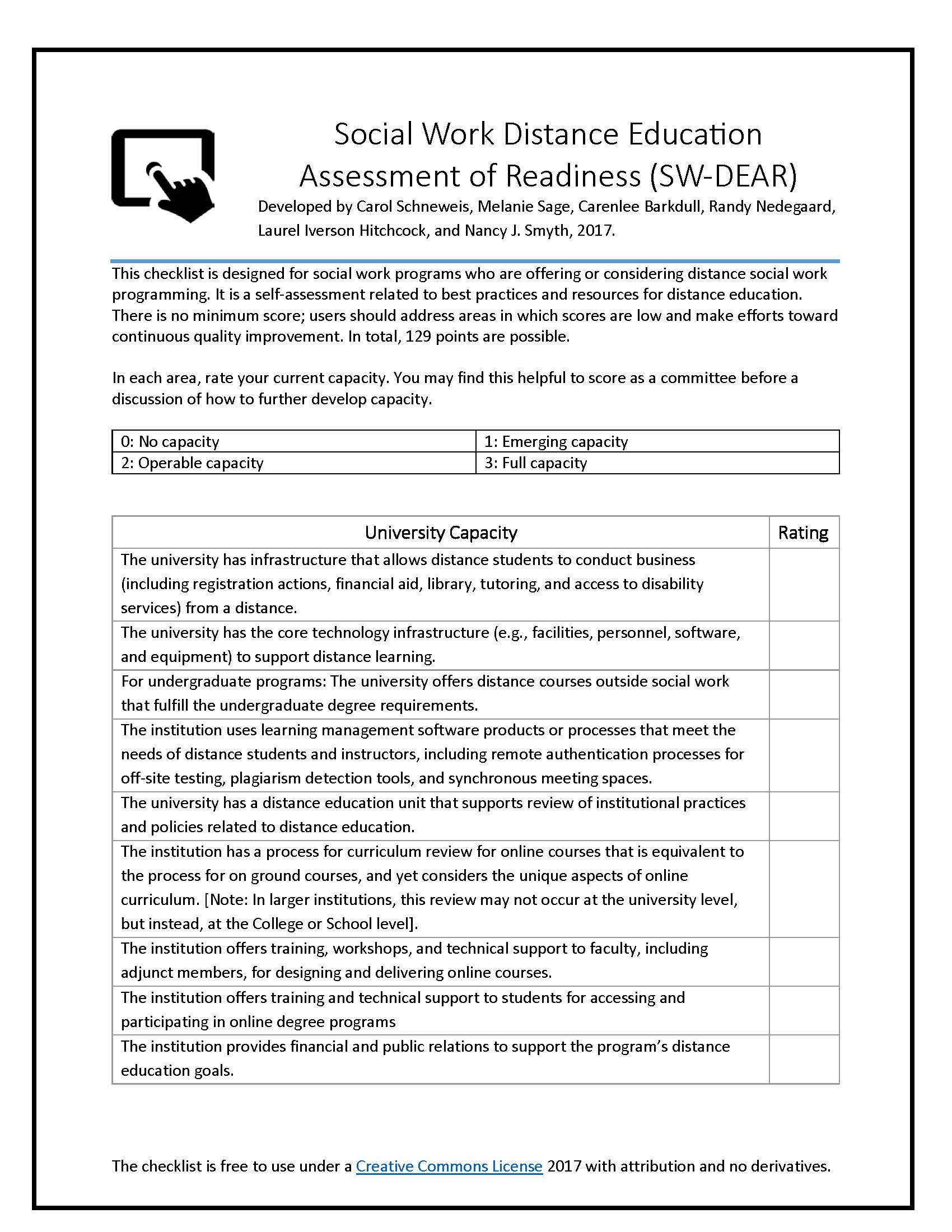 Social work programs develop online social work programs in different ways – converting courses overtime until the entire curriculum is online; launching designated online cohorts; insourcing (hiring faculty to teach online); or outsourcing (hiring an outside firm to put your program online), including varying degrees of faculty autonomy in developing and teaching an online courses. Regardless of the approach, a first step in the process is assessment of a social work program’s readiness for online programming, and a reason for a struggling online program often has to do with stretched capacity. Many campus-wide issues must be considered before launching any type of fully online programming. These considerations include the ways in which online programming makes education more, or less, accessible to different populations of students, gatekeeping concerns, and implicit curriculum issues. To help social work programs consider capacity issues related to online programming, we have collaborated with the faculty members Carol Schneweis, Carenlee Barkdull, and Randy Nedegaard at the University of North Dakota’s Department of Social Work to develop the Social Work Distance Education Assessment of Readiness Checklist (SW-DEAR) which programs can use to assess readiness to launch online programming, and identify opportunities to strengthen current programming.
This checklist is a self-assessment related to best practices and resources for distance education. The assessment includes 43 items that cover the following areas of capacity:
Review of Teaching & Learning in Social Work for 2017
 One of my favorite things to do at the end of the year is to read all of the “year-in-review” lists. Books, records, movies, top ten social work journal articles – it doesn’t matter what the list is about, I’ll read it. I am always curious how and why people choose to rank their favorite things from the year. This must be because I find it hard to choose a favorite book or movie when there are so many good options, and how can I exclude anything as a social worker, the profession that loves diversity and strives for inclusion. So for 2017, I offer a list for the Teaching & Learning in Social Work Blog. Not the top-ten blog posts, but the entire year. Here are the numbers:
Number of Blog Posts in 2017 – My goals was to write or publish at least two posts a month, which happened more months than not:
Total Blog Posts = 25
Highest number of Blog Posts published in one month = 6 (October)
Lowest number of Blog Posts published in one month = 0 (August)
Guest Educator Posts in 2017 – Another goal I have for this blog is to provide a space for others to share their work, particularly work that does not fit into the traditional academic publication venues. For 2017, I am thrilled that eight social work educators wrote seven different blog posts about their scholarship of teaching and learning for the blog. I want to thank all of these authors for sharing their work and for all they do to educate future social workers!
Scholarship Dissemination Posts – My final goal for the year was to write more about my own scholarship by sharing content from conference presentations and any published articles. I published seven posts about national conference presentations with colleagues, and wrote about one article I had published in 2017. Clearly, I am doing more conferencing than publishing.
Below is a list of this year’s post grouped around the topics of assignments, projects, guest educator posts, and conference presentations.

Teaching & Learning in Social Work by Laurel Iverson Hitchcock is licensed under a Creative Commons Attribution-NonCommercial-ShareAlike 4.0 International License