Navigating AI in Social Work Education
Editor’s note: In this blog post, four social worker educators share a sample from their new and free resource about using Artificial Intelligence (AI) in social work education. Alexander Rubin, LCSW, is a clinical assistant professor based in field education at the University at Buffalo School of School of Social Work. He specializes in community partnership development, field-specific teaching, and innovation in field education. Michael Lynch, LMSW, is a clinical associate professor at the University at Buffalo School of Social Work. He specializes in experiential learning, community partnerships, and the use of technology in social work practice and education. Todd Sage, Ph.D., MSW, is a clinical associate professor at the University at Buffalo School of Social Work. He is the chemical dependency track coordinator and mental health track chair. He researches technology and child welfare and enjoys integrating emerging technologies in the classroom and as a field instructor. Melanie Sage, Ph.D., LCSW, is a tech consultant for universities, social work departments, and social work agencies. She is an expert in generative AI, machine learning in social work, social media use, online education, and teaching with technology. She also works with agencies to train staff in Motivational Interviewing.
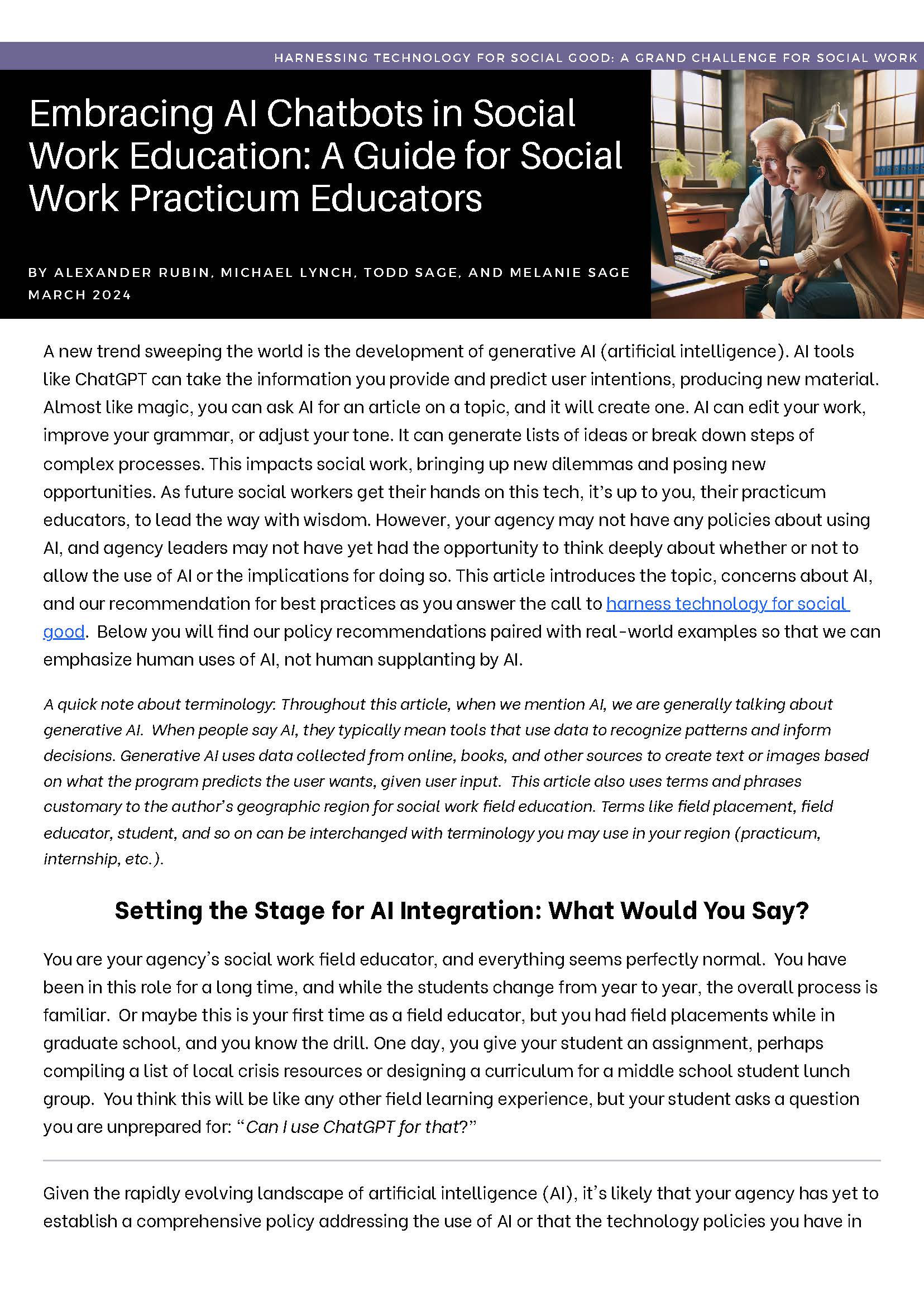
As social work educators, we find ourselves at a point where the capabilities of generative artificial intelligence (AI) tools like ChatGPT intersect with our professional practice more and more often, and we ponder these challenges with much philosophical debate in academic settings. But we send our students out to their practicum sites, and the debates are no longer philosophical; real-life decisions affect agencies, students, and clients, and these challenges must be thoughtfully and practically addressed. The emergence of AI has outpaced the development of comprehensive policy in numerous professional settings. This is why we wrote an article to offer guidance and considerations for the social work field educator with a student placed in their agency. Our goal is to introduce use cases, debates, and potential policies. The full article can be downloaded here and shared with your local social services agencies.


Teaching & Learning in Social Work by Laurel Iverson Hitchcock is licensed under a Creative Commons Attribution-NonCommercial-ShareAlike 4.0 International License