Twitter for your Professional Collaboration Network (PCN)
Editor’s Note: This post is one in a series about how technology can be used to develop and sustain one’s professional network. The idea for this post came from a think tank hosted by the University at Buffalo’s School of Social Work in June 2019, looking for a way to teach students in their new online Doctorate of Social Program (DSW) program about how to develop key stakeholder networks in relation to a substantive topic area. In this series, we are exploring the concept of a Professional Collaboration Network (PCN), which are technology-mediated user-centered relationship constellations designed to enhance or enrich connections, knowledge, and professional opportunities. This post covers how you can use Twitter to create and support your PCN.
In light of our living in a time of rapid technological change and our professional mandate to keep up-to-date with the advances in our field, (Council on Social Work Education, 2015; National Association of Social Workers, 2018), social workers may benefit from building a professional collaboration network (PCN). We previously defined what a Professional Collaboration Network is this blog post: What is a professional collaboration network and why do you need one?
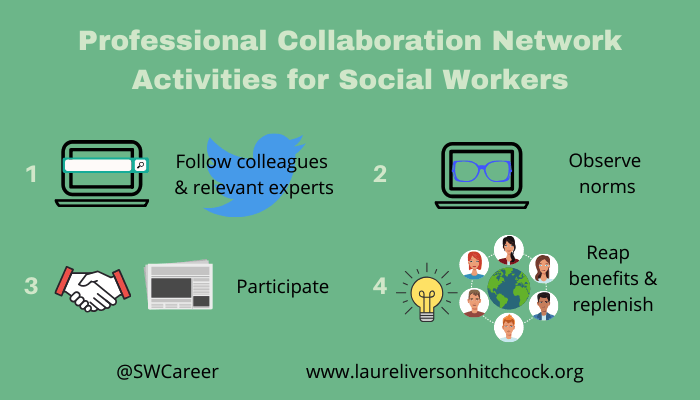
In essence, a PCN is created by social workers who connect with other professionals online for the purpose of learning and exchanging information. Prior to the ubiquitous use of the internet, professionals would typically keep up with the latest developments in their field via networking with their peers at conferences and continuing education opportunities, as well as via printed newsletters, magazines and trade publications. Nowadays, there are many technological tools to facilitate interactions with individuals across different disciplines, states or the world. PCNs typically include various online communities such as Twitter, LinkedIn, Facebook, social bookmarking sites and more.
Podcast Assignment for the Social Work Classroom
Editor’s Note: This blog post shares information about a podcast assignment developed and implemented in multiple social work classrooms over the past year. This assignment is a collaboration between myself and Melanie Sage, Todd Sage & Michael Lynch of the University at Buffalo’s School of Social Work. We share a copy of the assignment and rubric along with information about why social work educators might want to try this assignment in their own classroom.

Podcasts are now a well-known part of social work education. With so many different types of social work podcasts, it is easy for an educator to assign a podcast instead of an article, asking students to listen instead of reading. Examples of podcasts designed specifically for social work include:
- The Social Work Podcast by Dr. Jonathan Singer
- inSocial Work Podcast Series by the University at Buffalo’s School of Social Work
For a more comprehensive list of podcasts, check out this blog post written by one of us (Melanie):
Briefly, a podcast is an audio file made available on the Internet for downloading to a portable media player, computer, or other device. Podcasts are easy to create and do not require many technical skills which making the technology a good fit for student assignment and for faculty who do not have a lot of technology experience. One of us (Laurel) has been using and writing about podcast assignments for several years. Here are links to a series of posts she wrote back in 2014 when she first started using podcasts in her classroom:


Teaching & Learning in Social Work by Laurel Iverson Hitchcock is licensed under a Creative Commons Attribution-NonCommercial-ShareAlike 4.0 International License