FERPA & Social Media: Thoughts for Social Work Education
 What about FERPA? This is one of the most common questions I hear when presenting about using social media in the classroom. FERPA, the Family Educational Rights and Privacy Act, is the US federal law that protects the privacy of students’ educational record, and ensures that students have some control over their records. Examples of what is included in an educational record at the post-secondary level include grades, transcripts, class lists, student course schedules, and student financial information. Social work educators are often very aware of privacy and disclosure of personally identifiable information because of our practice backgrounds and the NASW Code of Ethics, so FERPA makes sense to us. It is understood that we should abide by FERPA and our professional standards of privacy and informed consent while modelling appropriate ethical standards for our students. However, this does not mean that social media is off-limits as an educational and professional development tool (Drake, 2014). Rather it means that as social work educators, we can use social media with students as long as we do so in ethical and legal ways (Rodriguez, 2011).
The purpose of this post is to provide some examples and best practices for FERPA-compliant social media assignments based on my understanding and experiences, and insights from colleagues. As with any ethical challenge, there are no black or white answers, but it is my hope that information in this post will provide insight on how social work educators can embrace the benefits of social media assignments while being mindful of the risks. And there are many benefits to using social media as social workers such as contributing to public conversations, building relationships with other practitioners, and staying current on news and research. Further, helping social work students develop the values and skills to professionally and ethically use social media is included in Council of Social Work Education’s 2015 Educational Policy and Accreditation Standards.
Here are ways I work to ensure that I am being ethical and professional with social media in the classroom:
Harnessing Social Media for Social Good at #CG4SW
 Last week, Melanie Sage and I led a discussion at the Social Work’s Grand Challenge Initiative Conference (#GC4SW) held at the University of Southern California (April 25-28, 2017). We attended the last day of the conference, which focused on for Harnessing Technology for Social Good. If you are not familiar with this challenge, its focus includes leveraging digital and social technologies to enhance, improve, and expand the reach and influence of social services, evidence-based social work practices, and innovative programs. Two white papers outline how social work can use technology to help individuals, communities, and organizations:
The use of social media is omnipresent in our daily lives, and ahead of policy and ethics in social work. Technology policy standards typically do not address concerns of social workers, including communication with clients, and professional values of privacy and confidentiality, safety, and self-determination. As a profession, we have few research studies about the use of social media in practice and mixed professional guidance around how to best engage with social media as part of our work with clients, constituents, and communities. Some in social work take a risk-averse approach to social media, limiting how and who they interact with on virtual platforms such as Facebook, Twitter, and Instagram. However, this Grand Challenges supports broader thinking and creativity in how social workers can engage with social media, especially to address the 11 other grand challenges.
As part of our discussion, we proposed that social media can be a tool to help social work academics and practitioners to discover and share knowledge as well as build relationships for collaborative work. Social media platforms are well-placed to allow social workers across the professional continuum to engage with each other, creating communities of learning and practice that bridge the gap between practice and research in social work. We suggested four practices with social media for advancing the Grand Challenges for Social Work:
Day Two of #SWDE2017 – Professional Learning Networks for Social Work
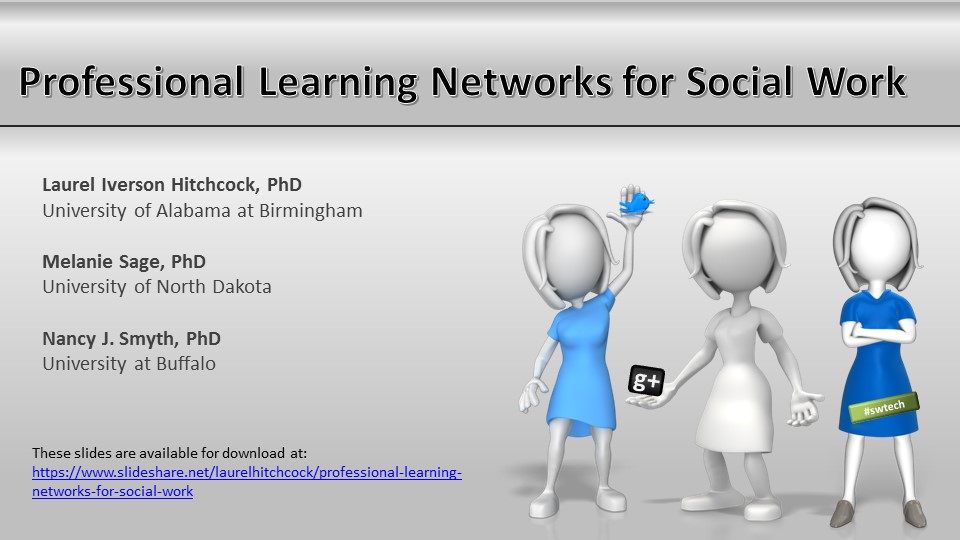 On April 13th, Melanie Sage, Nancy J. Smyth and I presented at the third annual Social Work Distance Education Conference sponsored by Our Lady of the Lake University’s Worden School of Social Service.
Our workshop informed participants about the mechanics as well as the advantages and disadvantages of professional learning networks (PLN), both as a scholar and in the classroom. A professional learning network (also known as a personalized learning network) includes technology-based tools and processes used by a social worker to stay up-to-date and share information about current news, practice knowledge, and the latest research findings. Participants learned how to establish and grow their own PLN, integrate PLNs into a classroom or curriculum, and appreciate how the theory of Connectivism (Siemens, 2005) informs the practice of PLNs.
You can access a copy of the slides here: https://www.slideshare.net/laurelhitchcock/professional-learning-networks-for-social-work.
A copy of the Professional Learning Network (PLN) Worksheet shared during the session is available here: https://drive.google.com/file/d/0ByR_E-iQH7PdT2t1WV9YYnlZV00/view?usp=sharing
Day Two of #SWDE2017 – Integrating Technology-rich Assignments in the Curriculum
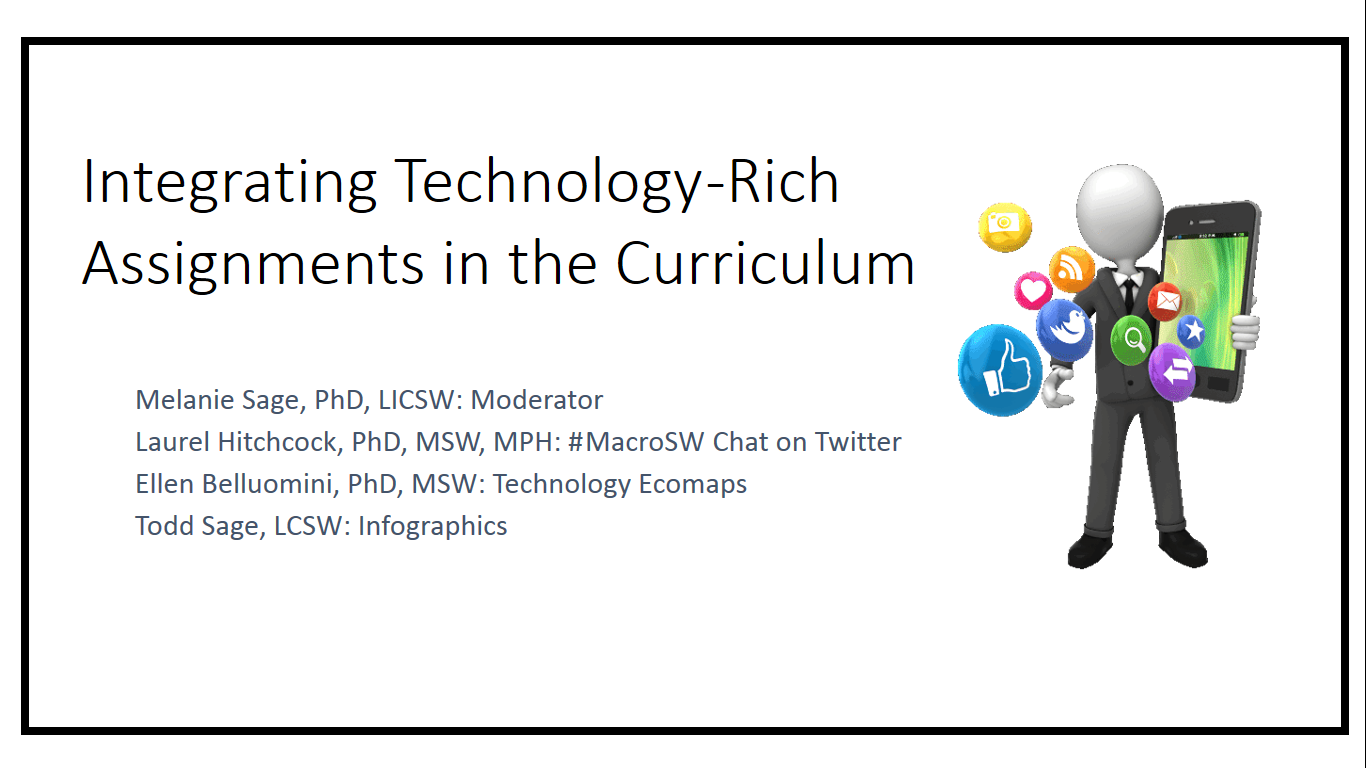 From April 12-14, 2017, the third annual Social Work Distance Education Conference was sponsored by Our Lady of the Lake University’s Worden School of Social Service in San Antonio, TX.
Melanie Sage & Todd Sage of the University of North Dakota, Ellen Belluomini of Dominican University, and I participated in a panel discussion about incorporating technology-based assignments in the social social work curriculum. We talked about three different types of technology-based assignments that can be incorporated into almost any classroom: Twitter Chats, Technology Assessments, and Infographics.
You can access a copy of the slides here: https://www.slideshare.net/laurelhitchcock/integrating-technologyrich-assignments-in-the-curriculum. We also have some assignment specific resources:

Teaching & Learning in Social Work by Laurel Iverson Hitchcock is licensed under a Creative Commons Attribution-NonCommercial-ShareAlike 4.0 International License